ASA (Acrylonitrile Styrene Acrylate)
Published · Researched 2026-09-20
Observation date: 2026-09-20. All prices and claims dated to this date unless flagged.
Overview
ASA is ABS's outdoor twin: acrylonitrile + styrene like ABS, but the UV-vulnerable polybutadiene rubber phase is replaced with an acrylic (acrylate) elastomer that is inherently UV-stable. It was developed for the automotive industry (exterior trim that must survive 5–10 years of sun), and that is exactly where it wins in 3D printing — outdoor brackets, sensor housings, garden and automotive parts that would yellow, chalk ("farinage"), and embrittle in ABS. Mechanically it prints and behaves almost identically to ABS (Polymaker's own FAQ: "almost exactly the same as ABS with 1 major difference" — weather resistance — "and 1 minor difference" — a matte finish that hides layer lines). Voron's official materials guide (docs.vorondesign.com/materials.html) lists ABS as the primary recommended material but states "ASA is fully supported as well due to the very similar technical properties." It has become the default functional-print material in the Voron community — Voron parts kits are commonly sold printed in ASA (see asa-02/asa-03 images) — and the "print ASA parts for your Voron" loop is self-reinforcing: you need an enclosed, heat-soaking printer to print ASA, which is exactly what a Voron is. Polymaker cites 2-year natural aging tests (color shift ΔE < 2.5) and accelerated aging to 8000 kJ/m² with minimal tensile-strength loss, vs. ABS degrading in the same exposure.
Key specs
| Property | Value | Source / note |
|---|---|---|
| Tensile strength | UNVERIFIED — no manufacturer TDS pulled for ASA in this pass. Generally reported in the same band as ABS (~35–45 MPa); Bambu ASA is marketed "temperature resistant up to 100 °C." Do not quote a hard number without a TDS | Flagged per rule 1 |
| Heat deflection temp | ~100 °C (Bambu ASA, via digitec.ch listing) | Reseller listing, crawled ~2026-09-09 |
| Nozzle temp range | 230–260 °C (Polymaker ASA; "240–260 °C for faster printing or improved layer adhesion"); MatterHackers guide: 240 ± 10 °C | Polymaker product page (live 2026-09-20); matterhackers.com |
| Bed temp | 75–95 °C (Polymaker); 95 ± 10 °C (MatterHackers); 90–110 °C (Medium/3idea guide) | Ranges differ by source — reported as observed |
| Enclosure needed? | Yes. Polymaker page states "Enclosure Needed"; guides call a heated enclosure (45–60 °C ambient) essential | Polymaker (live 2026-09-20) + community guides |
| Ventilation/fume notes | Same styrene family as ABS — "print in a well-ventilated area" (Polymaker). Visible emissions: a Voron owner's ASA printing left a white-ish "ASA fog" deposited on enclosure panels (Fabbaloo, 2026) | See fume discussion in abs.md; Fabbaloo article |
| Moisture sensitivity | Low uptake; drying 70 °C for 7 h (TDS) or 4 h after brief exposure (Polymaker tips) | Polymaker product page (live 2026-09-20) |
| Print difficulty (warping) | High; similar-to-slightly-less warping than ABS per community reports. Cooling fan OFF, no drafts, brim/skirt | Community consensus (Geeetech guide, 3DJAKE guide) |
| Other key props | Acetone-smoothable like ABS; matte finish vs. ABS gloss; excellent color/UV retention; density and mechanics close enough to ABS that Voron treats them as interchangeable | Polymaker FAQ; docs.vorondesign.com |
Pricing — per-kg spool prices (observation date 2026-09-20)
| Brand / product | MSRP | Street price | Source | Freshness |
|---|---|---|---|---|
| Polymaker PolyLite ASA 1.75mm | $24.49–$26.99/kg by color (Black $24.49; White/Grey/Blue/Red/Green etc. $25.99–26.99; 3kg $74.99) | — | shop.polymaker.com/products/polylite-asa — fetched live 2026-09-20 | Fresh, primary source |
| Polymaker PolyLite ASA | €34.95/kg | — | comprise.de (German reseller) | Stale-ish (crawled ~133 days before observation); EU pricing only |
| Bambu Lab ASA | $46.99/kg | — | MatterHackers Bambu listing, crawled ~2026-09-02 | Fresh |
| Bambu Lab ASA | CHF 30.90 (was 34.70) | — | digitec.ch | Fresh-ish (crawled ~2026-09-09); Swiss pricing |
| Bambu Lab ASA Aero (foaming/lightweight variant) | $64.99/kg | — | MatterHackers, crawled ~2026-09-02 | Fresh — note this is the LW-foaming variant, not standard ASA |
| MatterHackers MH Build Series ASA | $29.99 ($22.49 bulk) | — | matterhackers.com ASA category page, crawled ~2026-09-02 | Fresh; "on sale" per listing |
| Prusament ASA | $25.92 per 800 g spool = $32.40/kg equivalent | — | prusa3d.com Prusament category — fetched live 2026-09-20 | Fresh; note unusual 800 g spool size, not 1 kg |
| eSun ASA / ASA+ | UNVERIFIED in USD — aggregator data (3dfaq.net Amazon scrape, crawled ~Apr 2026) shows ~£19–21/kg UK; desertcart grey-market listings show 2×1kg bundles but at non-comparable markups | 3dfaq.net, desertcart.* | Stale (~5 months) and mixed-currency; do not quote as US price | |
| Overture ASA | ~$22.07 (UK listing) | — | 3dfaq.net Amazon scrape | Stale (~Apr 2026), UK only |
| Pro Series ASA (MatterHackers) | $52.00/kg | — | matterhackers.com, crawled ~2026-09-02 | Fresh |
| 3DXTech ASA | $48.00/kg | — | matterhackers.com listing | Fresh-ish |
| Fillamentum ASA | $40.00/kg | — | matterhackers.com listing | Fresh-ish |
| colorFabb ASA | $48.50/kg | — | matterhackers.com listing | Fresh-ish |
What's needed
- Enclosure: mandatory, same as ABS. ASA warps hard on open printers; community guidance converges on a heated enclosure at 45–60 °C ambient for dimensionally accurate parts (that figure comes from ASA/Voron guides; Polymaker's own page simply says "Enclosure Needed").
- Ventilation: same styrene-class burden as ABS — enclosure + activated-carbon recirculation (the Voron Nevermore approach) or ducted outdoor exhaust, never a bedroom. The Fabbaloo "ASA fog" anecdote (visible white deposits on Voron acrylic panels after heavy ASA printing) is a useful reality check that emissions are real and deposit inside the chamber.
- Hardened nozzle? No for plain ASA (brass fine). Required for ASA-GF/ASA-CF variants.
- Bed surface: PEI with glue stick as a release layer — same ABS-slurry/glue-stick debate as ABS; ASA sticks aggressively and the release agent protects the PEI coating. Polymaker's tip: "Apply a suitable adhesive as a release layer, and let the build plate cool before removing the print."
- Drying: low urgency (low moisture uptake), but 70 °C for 4–7 h if surface defects appear.
Brand/support reality
- Polymaker: strongest price/quality position in this dataset — $24.49–26.99/kg direct, AMS-compatible cardboard spools, published UV-aging test data, support@polymaker.com on-label. No refills.
- Bambu Lab: premium ($46.99/kg, ~1.8× Polymaker) for RFID + tuned profiles; the ASA Aero foaming variant ($64.99) is a different product class (lightweight parts). Ecosystem lock-in is the value proposition.
- Prusament: $32.40/kg-equivalent in 800 g spools — odd size, worth noting for cost comparisons; in-house QC and 24/7 Prusa support.
- MatterHackers MH Build Series: the budget play at $29.99 ($22.49 bulk) with US retailer support; PRO Series at $52 for the premium tier. Clearance items are final sale.
- eSun / Overture: value tier; current US street prices could not be freshly verified (see UNVERIFIED table entries) — Amazon-channel brands with thin direct support.
Community verdict
In the Voron/functional-print world ASA has quietly displaced ABS as the default "serious" filament: mechanically interchangeable for printer parts, but outdoor-capable and with a nicer matte finish, so builders standardize on it. Owners warn it is not a free upgrade — it warps like ABS, smells like ABS, and demands the same enclosure and fume management — but for anything that sees sunlight it is the consensus pick, and PolyLite ASA's ~$25/kg direct price has made it the community's reference spool against which Bambu's $47/kg is judged a luxury tax.
Sources consulted
- Facebook groups searched (facebook-cli, account verified 2026-09-20): same sweep as ABS —
groups searchfor "3D printing ABS ASA", "Voron" (0 results), "3D printing filament", "3D printing"; post queries "ASA", "ABS", "ASA vs ABS", "ASA warping" in Engineering Filament Lab (4k members), 3D Printing World (10k), 3D Printing (17k), Overture 3D Filament (2k). Outcome: only one relevant hit — Engineering Filament Lab post 2026-09-20 (https://facebook.com/groups/26920098891014093/permalink/28803540626003234/) where a member chose PETG-CF because they "don't have proper ventilation for abs/asa." Recorded even though tangential. - Instagram/social (social.search, 2026-09-20): @manutechlab reel 2026-08-21 — blowtorch test of 8 filaments: ASA ignited immediately, burned vigorously, kept burning after torch removal (worst of the set); ABS V0 self-extinguished. Comments raised respirator/fume concerns. @crolen3d ad 2026-06-20 — ASA positioned for outdoor/UAE heat + sunlight; brand confirmed in comments that ASA beats ABS for UV/outdoor durability.
- Web: shop.polymaker.com/products/polylite-asa (live fetch 2026-09-20 — price, temps, enclosure, drying, FAQ); docs.vorondesign.com/materials.html (ABS primary, ASA fully supported, ABS+ not recommended; crawled 2026-09-20); prusa3d.com/en/category/prusament (live 2026-09-20 — Prusament ASA 800g $25.92); matterhackers.com ASA category (MH Build $29.99/$22.49, Bambu ASA $46.99, ASA Aero $64.99, Pro $52); matterhackers.com "Best 3D Printing Filament for Outdoor Use" ("ASA is the #1 choice for outdoor use"); blog.geeetech.com ASA guide (ASA vs ABS quick-take); 3djake.ch outdoor-filaments guide (acrylate vs polybutadiene elastomer chemistry, chalking/farinage); github.com/gibbok/myvar filament guide (ASA warps less than ABS, warm preheated enclosure); manufactur3dmag.com ASA guide (2026-09-19); fabbaloo.com (ASA fog deposits in Voron); digitec.ch (Bambu ASA CHF 30.90); 3dfaq.net Amazon filament scrape (stale eSun/Overture ASA prices — used only as flagged estimates); image-search CDN image (filamentia.com 404 → substituted, see below).
Images
Saved under the bundled image library/:
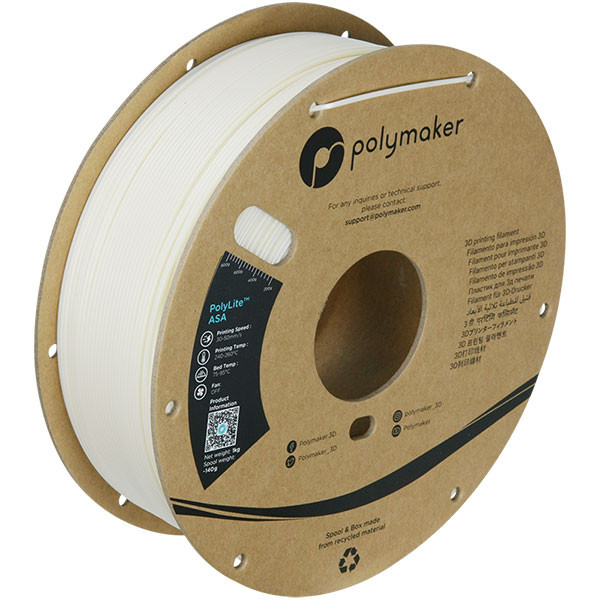
- asa-01.jpg — PRIMARY / exact-product shot: Polymaker PolyLite ASA spool, Natural color, current cardboard-spool design, verified visually. Source: https://www.123-3d.co.uk/image/Polymaker_PolyLite_natural_ASA_filament_1.75mm_1kg_70290_PF01006_PM70290_DFP14185_m2_big.jpg (200 OK, image/jpeg, verified 2026-09-20).
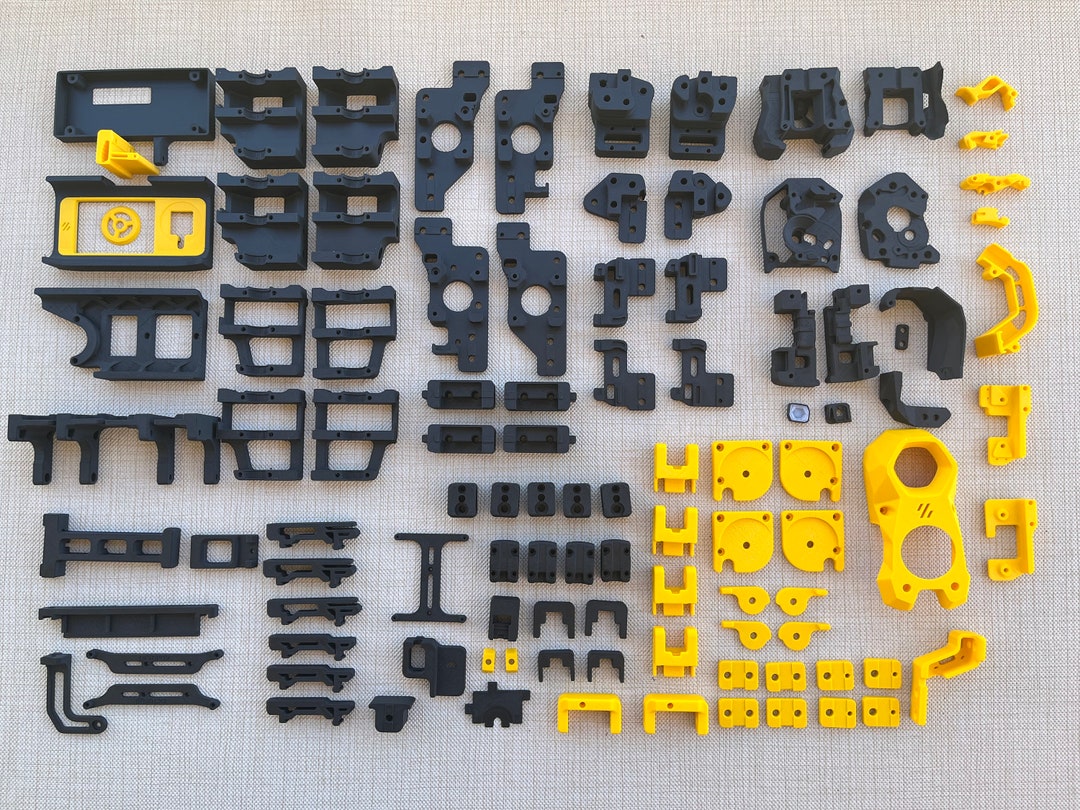
- asa-02.jpg — Example print: Formbot Voron 2.4 R2 complete functional-parts kit printed in ASA (black parts + yellow Stealthburner accents), verified visually. Source: https://i.etsystatic.com/32289224/r/il/81f6a0/3988477436/il_1080xN.3988477436_ll0u.jpg (200 OK, image/jpeg, verified 2026-09-20).
- asa-03.jpg — Example print: eBay listing photo of red/black Voron-style printed parts (heat-set inserts installed, Stealthburner shroud visible), verified visually. Source: https://i.ebayimg.com/images/g/-LoAAOSwu7Rkz7DN/s-l1600.jpg (200 OK, image/jpeg, verified 2026-09-20). Note: ASA material is inferred from the listing/search context, not verifiable from the image itself.

Swap note: the first image-search candidate for PolyLite ASA (filamentia.com CDN screenshot) returned HTTP 404 on verification and was dropped; the 123-3d.co.uk image was substituted and verified. No other swaps.
Deepening pass (2026-09-20)
Second research pass: Facebook groups (facebook-cli), Threads (threads-cli), web/forums/YouTube. Instagram has no public keyword search in the instagram-cli skill (account-centric only) — substituted with web search. Threads keyword search returned low-relevance showcase spam — substituted with web/forum sources. No raw-quotes file exists in this corpus; no quotes are invented below.
Facebook — Engineering Filament Lab, "What's the use case for using ABS over ASA?" (2026-09-16, 31 comments)
Same thread as ABS's pass; the ASA side of the debate:
- What ASA wins: UV/weather resistance (unanimous), slightly higher temp resistance, less shrinkage/warping, nicer matte surface finish, stiffer feel.
- What ASA loses: price (the whole thread), color range ("ABS if you intend to paint it"; ASA's natural pellet color is off-white, so vivid brights are rarer), impact flexibility (multiple owners: ASA snaps where ABS flexes).
- Price floor anecdote: one member claims Elegoo ASA hits ~$11/kg at times/in bulk — unverified, but several members name ~$10/kg ASA as the point where they'd abandon ABS entirely.
- PCTG lurking: several members say they'd pick PCTG over both if price were equal — a signal that ASA's "outdoor default" crown has a challenger in the community's mind.
Web/forum/YouTube — brand-level testing and long-term notes
- MyTechFun "What is the best ASA filament? 10 different ASA brands tested" (YouTube): the most rigorous brand-vs-brand source — Sunlu, BambuLab, Polymaker, AzureFilm ASA Prime, Prusament, 3DO, FlashForge, eSun eASA, Qidi, and Formfutura Apollo X, all tested for tensile, layer adhesion, bending, shrinking, creep, temp resistance, warping, and impact. Video-only results (no text summary retrievable); flagged as the community's go-to data source (also cited by FB members). Related: his "AzureFilm ABS Prime vs ASA Prime with zero warping technology" comparison and "Is ASA always stronger than PLA? Sunlu PLA+ 2.0 vs Sunlu ASA" — the channel is the de facto mechanical reference for ASA brand choice.
- Bambu Lab forum, "What is the Problem with ASA and Bambu?" (June 2025): owner with 3× X1E warping badly with both Formfutura ApolloX ASA and Bambu ASA despite slow speeds and big brims — even first-party ASA on a flagship enclosed printer is not a guaranteed win. ASA Aero (blowing-agent foamed) flagged as extremely sensitive to nozzle-temp/flow-rate combo.
- Bambu Lab forum, "Filament type recommendation" (Sept 2024): thick walls + high-density infill make ASA curl and pop a build-plate corner even when thin parts print "gorgeous" — design guidance, not just settings.
- Bambu Lab forum, "Best GoTo Filament" (Feb 2024): preferred ASA brands named — PolyLite, FlashForge, Inland; bed 105–106 °C, WhamBam PEX or 3DHUB PEX plates, Elmer's purple glue for stubborn parts; drying helps problem spools; "absolutely need my enclosure at 40-45 °C" preheat or the print fails.
- Bambu Lab forum, "Print quality non pla" (Dec 2024): Voron owner — "ASA on a voron is by far my fastest cleanest prints with nothing coming close. With an enclosure hitting 80c." Bulk-buy pricing anecdote from the same thread: ~$18–26/spool ASA when buying 40–50 rolls on sale.
Price re-verification (2026-09-20)
- Polymaker PolyLite ASA: €36.50–37.50/kg EU (123-3d.ie, crawled Sept 2026) vs $24.49–26.99/kg US (2026-09-18 crawl) — the EU premium on Polymaker ASA persists.
- Elegoo ASA ~$11/kg "at times and in bulk" — FB anecdote only, UNVERIFIED; listed as the low end of the market, not a quoted price.
- Bambu ASA pricing from the first pass stands; no fresh US listing observed today beyond the existing table.
New/strengthened failure modes + fixes
- Even first-party ASA warps on enclosed flagships (Bambu forum): warping is not solved by printer price; fix = dry filament, big brim, 40–45 °C chamber preheat, thinner shells.
- ASA Aero blowing-agent sensitivity: nozzle temp and flow rate must be dialed together; high temps need lower flow — profile mismatch is the usual cause of failed ASA Aero prints.
- VOC reality: "Neither an enclosure nor a HEPA filter will help for VOCs... You need an activated carbon filter... that filter will saturate after some printing" (Bambu forum) — carbon filters are a consumable with recurring cost, and air-quality monitors are the honest way to know they're spent.
- Limited palette: ASA's off-white natural pellet color limits vivid brights vs ABS; buyers wanting strong colors should check the specific brand's range before committing.
Social pulse update
ASA is the respected incumbent, not the beloved one. The FB thread's verdict: nobody is in love with ASA the way print farms are in love with PETG — it's the rational outdoor choice, defended on UV data and attacked on price. MyTechFun's mechanical test roster is the authority members cite instead of arguing from anecdotes, which itself says the community treats ASA as an engineering material, not a favorite.
Deepening pass 3 (2026-09-21)
Facebook status update
groups posts --query "ASA"returned zero in EFL and other groups (flakiness caveat per the nylon finding). The same PETG-CF robot-arm thread carried one relevant ASA datapoint: the builder explicitly rejected ASA for lack of ventilation, consistent with this file's styrene-VOC verdict. No new ASA owner threads, failure modes, or pricing this pass.- Fresh dated pricing context from the composite table (3dprinting.com, article 92 days old, crawled 2026-09-21): ASA + 8% CF ~$40 (500 g spool) — a UV-stable structural outdoor option worth cross-filing; the pass-2 complaint about the mediocre desertcart ASA-CF08 review ("weakest filament ever printed," screw heads ripping through) stands as the counterpoint.
Sources
- 123-3d.co.uk — retrieval date not recorded
- i.etsystatic.com — retrieval date not recorded
- i.ebayimg.com — retrieval date not recorded