Nylon PA6/PA12 (incl. PAHT-CF style high-temp nylon)
Published · Researched 2026-09-20
Overview — what it is, best uses, key context
Nylon (polyamide) is the engineering workhorse of FDM: tough, abrasion-resistant, chemically resistant, and self-lubricating — ideal for gears, bearings, pulleys, jigs, fixtures, and functional parts that see load and wear. The catch is legendary: nylon is extremely hygroscopic (PA6 absorbs far more than PA12), so a filament dryer / dry box is mandatory and you generally print straight from it; wet nylon pops, strings, and foams. It also wants an enclosure (warping) and 250–300 °C nozzles. The market splits into: (1) plain nylon — eSUN ePA, Xtellar (formerly Taulman) 645/910 lines; (2) filled nylon — carbon/glass fiber grades that print stiffer with less warp: MatterHackers NylonX (PA12-CF) / NylonG (glass), Polymaker Fiberon PA6-CF20 (rebranded from PolyMide PA6-CF, same formula); (3) high-temp grades — Bambu PAHT-CF (PA12-based, HDT 194 °C), Polymaker PA12-CF / PA612-CF, Prusament PA11-CF (bio-based PA11, annealable to 122.5 °C HDT). PAHT-CF base polymer: PA12 — confirmed, not disputed. Bambu's own copy states "a composite of PA12 and carbon fiber"; a reseller's Bambu parameter table lists "Composition: PA 12 and other long-chain PA, carbon fiber". Filled nylons require hardened steel nozzles (abrasive) and dry-box printing at <20% RH. Prices observed 2026-09-20.
Key specs
| Property | Bambu PAHT-CF | Polymaker Fiberon PA6-CF20 (ex-PolyMide PA6-CF) | MatterHackers NylonX (PA12-CF) | eSUN ePA (plain nylon) | Xtellar (ex-Taulman) 645 | Prusament PA11-CF Black |
|---|---|---|---|---|---|---|
| Base polymer | PA12 + chopped CF (official) | PA6 + 20 wt% chopped CF | PA12 + ~20 wt% chopped CF | Nylon (PA6-type per mfr; exact grade not verified) | Nylon 645 (copoly; exact grade not verified) | PA11 (bio-based) + recycled CF |
| Tensile strength (MPa) | 92 ± 7 (mfr TDS via resellers; one reseller lists 88 ± 7 — minor discrepancy, flagged) | 109.3 ± 2.4 dry XY / 54.7 wet XY (printed + annealed) | UNVERIFIED | UNVERIFIED | UNVERIFIED | UNVERIFIED |
| HDT (°C) | 194 (0.45 MPa) | 215 (0.45 MPa) / 196 (1.8 MPa) | UNVERIFIED | UNVERIFIED | UNVERIFIED | up to 190 long-term (mfr); anneal boosts base PA11 to 122.5 |
| Nozzle temp (°C) | 260–290 | 280–300 | 250–265 | 230–260 | UNVERIFIED | 285 ± 5 |
| Bed temp (°C) | 80–100 (with glue) | 25–50 (do NOT exceed 50) | 60–65 | 80 | UNVERIFIED | 110 ± 10 |
| Enclosure | Required (not for open-frame) | "No heated chamber or enclosure needed" per Fiberon page (Warp-Free tech) — disputed by conventional nylon wisdom; report both | Recommended | Recommended | Recommended | Recommended + active filtration (odour/ultrafine particles per Prusa) |
| Moisture | Dry 80 °C, 8–12 h; keep <20% RH while printing | Dry 80 °C/12 h; moisture equilibrium 3.3% at 70% RH/23 °C/40 days — still hygroscopic | Dry before use (desiccant add-ons sold alongside) | Very hygroscopic | Hygroscopic | "Noticeably less hygroscopic than other polyamides" but "still somewhat hygroscopic" (Prusa) |
| Abrasive → hardened nozzle | Yes (CF) | Yes — destroys brass within a few hundred grams | Yes | No (plain) | No (plain) | Yes (CF) |
| Flame rating | UNVERIFIED | UNVERIFIED | UNVERIFIED | UL94-V2 (per mfr) | UNVERIFIED | UNVERIFIED |
Annealing note (Polymaker): PA6-CF20 should be annealed (recommended 100 °C/16 h, or 90 °C/2 h on older PolyMide sheets) to reach full mechanical/thermal properties; printed-but-unannealed properties are significantly lower. Prusament PA11 Natural: as-printed HDT under load only 58.7 °C → 122.5 °C after 110 °C/6–8 h anneal (may yellow slightly).
Pricing — per-kg spool prices (all observed 2026-09-20; USD unless noted)
| Brand / product | Size priced | Price observed | Per-kg equivalent | Source + date |
|---|---|---|---|---|
| Bambu Lab PAHT-CF | 1 kg w/ high-temp spool | $94.99 | $94.99/kg | Bambu Lab US store (crawled 8 h prior) + 3dherndon/shop3duniverse/gigaparts resellers, obs. 2026-09-20 |
| Bambu Lab PAHT-CF | 0.5 kg w/ spool | $49.99 | $99.98/kg | Bambu Lab US store (crawled 8 h prior), obs. 2026-09-20 |
| Bambu Lab PA6-CF | (size not stated — UNVERIFIED, likely 1 kg) | $42.99 | n/a — cannot compute per-kg | Bambu Lab US via shop.app (crawled 7 days prior), obs. 2026-09-20 |
| Polymaker Fiberon PA6-CF20 | 1 kg, $52.99 MSRP | $52.99 (sold out at obs.) | $52.99/kg | shop.polymaker.com (crawled 61 days prior — MSRP page, stock status stale), obs. 2026-09-20 |
| Polymaker Fiberon PA6-CF20 | 1 kg | $39.99 | $39.99/kg | Polymaker US wholesale (crawled 1 day prior), obs. 2026-09-20 |
| Polymaker PA12-CF | — | UNVERIFIED | — | Exists (Fiberon/PolyMide PA12-CF, 79.6 MPa dry tensile); no current retail price verified |
| MatterHackers NylonX | 0.5 kg | $63.00 | $126.00/kg (computed) | matterhackers.com (crawled 3 h prior), obs. 2026-09-20 |
| MatterHackers NylonX | 3 kg | $362.00 | $120.67/kg (computed) | matterhackers.com bulk (crawled 2 days prior), obs. 2026-09-20 |
| MatterHackers NylonG (glass-filled) | range across sizes | $70.00–329.00 | size breakdown UNVERIFIED | matterhackers.com category (crawled 14 h prior), obs. 2026-09-20 |
| eSUN ePA (plain) | 1 kg | ~$38 | ~$38/kg | facfox 2021 buyer's guide — STALE (2021); current street price UNVERIFIED |
| Xtellar (ex-Taulman) 645 Nylon | 1 kg, 2.85 mm | $60.00 | $60.00/kg | matterhackers.com (crawled 53 days prior), obs. 2026-09-20 |
| Prusament PA11 Natural | 800 g | $122 USD (import duties incl.) / €107 (VAT incl.) | ~$152.50/kg (computed) | Prusa blog launch post (27 days old — current), obs. 2026-09-20 |
| Prusament PA11-CF Black | 800 g | $99.99 | ~$124.99/kg (computed) | Prusa 2022 launch blog — STALE launch price; current store price UNVERIFIED |
Per-kg ladder (rounded, 2026-09-20): Polymaker PA6-CF20 ~$40–53 < Xtellar 645 $60 < Bambu PAHT-CF $95 < NylonX ~$121–126 < Prusament PA11 ~$125–153. Note NylonX has no 1 kg SKU — 0.5 kg and 3 kg only.
Discontinuity/rebrand flags: (1) Polymaker renamed PolyMide PA6-CF → Fiberon PA6-CF20 (official: "same proven formula... may print in a slightly darker black shade"); old PolyMide-branded stock may still circulate. (2) Taulman 3D → Xtellar (MatterHackers: "Xtellar (Previously known as Taulman)"); the task's "Taulman 910" no longer appears under the Taulman name — Xtellar 645/910-style SKUs live under Xtellar now; exact 910 availability UNVERIFIED.
What's needed
- Dryer / dry box — MANDATORY: Bambu PAHT-CF: dry 80 °C for 8–12 h before printing, print/store at <20% RH sealed with desiccant; Polymaker PA6-CF20: dry 80 °C/12 h; Prusament PA11: dry 90 °C/6–8 h before printing. PA6 absorbs the most; PA12/PA11 are markedly less thirsty but still need drying (PAHT-CF's wet-state mechanical decline is only 12–18% vs 40–45% for "normal PA-CF" per Bambu — better, not immune).
- Enclosure: strongly recommended for plain nylon (warping); Bambu states PAHT-CF is "unsuitable for use with open-frame printers"; Fiberon PA6-CF20 claims Warp-Free no-enclosure printing — treat as best-case, enclosure still helps.
- Hardened nozzle: mandatory for ALL carbon/glass-filled nylons (PAHT-CF, PA6-CF, NylonX/G, PA11-CF); Bambu: not compatible with 0.2 mm or stainless-steel nozzles for PAHT-CF (0.6 mm hardened recommended). Plain nylon prints fine on brass.
- Bed surface: glue stick / liquid glue or Magigoo PA on engineering/PEI plate; Bambu PAHT-CF: glue mandatory, bed 80–100 °C; Prusament PA11-CF: dedicated PA nylon sheet ($44.99, 2022 price) or equivalent.
- Ventilation/filtration: Prusa recommends enclosed chamber with active filtration for PA11-CF (odour + ultrafine particles).
Brand/support reality
- Bambu Lab: cheapest entry to CF-nylon ($95/kg PAHT-CF vs $126 NylonX); RFID profiles + high-temp reusable spool; 4.9-ish storefront ratings on engineering filaments. Support is ticket-based with mixed community reputation (not independently verified here). Regional price dispersion is large (US $95/kg vs AU A$159/kg).
- Polymaker: strongest published data in the category (ISO-tested TDS, dry/wet state tables, annealing procedures, printer presets wiki); Fiberon rebrand is current — verify branding when ordering. Global distributor network; US wholesale pricing notably cheaper ($40/kg).
- MatterHackers (NylonX/NylonG): US retailer-manufacturer, in-house support team, free US shipping; premium pricing ($121–126/kg for NylonX); clearance notched-spool variants exist ($29.81/0.5 kg — not AMS-safe, flagged on their site).
- Prusa (Prusament PA11): made in-house in Prague, ±0.04 mm tolerance, QR-traceable spools; glued spool sides (drying-safe); 800 g spools only; premium per-kg pricing (~$152/kg Natural). Requires their PA sheet or equivalent for adhesion.
- Xtellar (ex-Taulman): legacy nylon specialist under new brand; limited current retail footprint verified (MatterHackers carries some SKUs).
Community verdict
Nylon's community reputation is consistent across sources: it is the material makers reach for when PETG/ASA isn't strong or wear-resistant enough — gears, drone parts, and jigs are the canonical use cases — but the workflow tax is real (dryer, enclosure, hardened nozzle, glue, and often annealing). PA12-based grades (Bambu PAHT-CF, NylonX) are widely preferred over PA6 for moisture tolerance and dimensional stability; Bambu's wet-vs-dry data (12–18% property decline vs 40–45% for normal PA-CF) is the most-cited evidence for this. Prusament PA11 (especially the Natural variant launched ~Aug 2026) is gaining attention for low-friction gear applications, though its price per kg is the highest in this survey. Siraya Tech's FB group shows the ecosystem trend: PPA-CF/PAHT-CF frames paired with TPU 85A grips for functional prints.
Sources consulted
- FB groups searched (facebook-cli, account Luc Schurgers, verified 2026-09-20): same group searches as TPU item —
groups search --keywords "3D printing TPU nylon"(5 groups, poor keyword match) and--keywords "3D printing"(3D Printing World 10k, 3D Printing 17k, I Need a 3D File 324, Profitable Family Business 270, 3D Printing Club 2k).groups posts --query "nylon"in "3D Printing" (17k) → no results;--query "nylon"in Siraya Tech Filament Users (437) → no results. The Siraya group's TPU posts (7) are recorded in tpu.md. No nylon-specific community discussion was retrievable via FB groups. - IG/social (social.search, 2026-09-20): zeitgeist output focused on TPU maker content (see tpu.md); no nylon-specific maker posts surfaced in the top results.
- Web:
- https://store.thinglab.com.au/products/bambu-paht-cf ("composite of PA12 and carbon fiber"; $145 AUD/kg) — PA12 confirmation
- https://www.buildvolume.co.za/product-page/1-75mm-bambu-lab-paht-cf (full TDS: tensile 92±7 MPa, HDT 194 °C, 260–290 °C nozzle, 80–100 °C bed, dry 80 °C 8–12 h, <20% RH)
- https://www.crea3d.com/en/filaments/1302-bambu-paht-cf.html (€45.37/500 g; PA12 confirmation; 1.70% vs 0.88% water absorption table)
- https://3dexpress.my/product/bambu-lab-paht-cf/ (Bambu parameter table: "Composition: PA 12 and other long-chain PA, carbon fiber"; tensile 88±7 MPa — differs from buildvolume's 92±7, flagged; $94.99/kg price ref)
- https://us.store.bambulab.com/collections/all-filaments (PAHT-CF from $49.99 US; crawled 8 h prior)
- https://shop.3dherndon.com/products/bambu-lab-paht-cf-with-spool (1 kg $94.99 / 0.5 kg $49.99; crawled 1 day prior)
- https://shop3duniverse.com/collections/filament/products/bambu-lab-paht-cf-high-temperature-nylon-carbon-fiber-1-75mm-black (same pricing)
- https://www.smith3d.com/shop/materials/special/carbon-fiber/bambu-lab-paht-cf-1kg-1-75mm-with-rfid-carbon-fiber-reinforced-high-temperature-nylon-high-tensil-strength/ ("PA12 and long-chain nylon"; hardened 0.6 mm recommended)
- https://shop.app/products/7649387806856/tpu-95a-hf (Bambu US: PAHT-CF $49.99; PA6-CF $42.99, size unstated)
- https://shop.polymaker.com/products/fiberon-pa6-cf20 (Fiberon PA6-CF20 = PolyMide PA6-CF formula; 1 kg $52.99 sold out; 0.5 kg $39.99)
- https://us-wholesale.polymaker.com/products/fiberon-pa6-cf20 (1 kg $39.99)
- https://fiberon.polymaker.com/product/pa6-cf20/ (tensile 109.3 MPa dry XY, HDT 215 °C, 280–300 °C, dry 80 °C/12 h, anneal 100 °C/16 h; "no heated chamber needed" claim)
- https://polymaker.com/wp-content/tech-docs/PolyMide%20PA612-CF%20PIS%205.0.pdf (PA612-CF / PA6-CF / PA12-CF comparison: PA12-CF tensile 79.6 MPa dry)
- https://www.matterhackers.com/store/3d-printer-filament/nylonx-carbon-fiber-nylon-filament-1.75mm (NylonX: PA12 + 20% CF, 0.5 kg $63, 250–265 °C, bed 60–65 °C; crawled 3 h prior)
- https://www.matterhackers.com/store/c/matterhackers-3d-printer-filament (NylonX $55.44–362 range; NylonG $70–329 range)
- https://www.matterhackers.com/store/c/bulk-materials (NylonX 3 kg $362; Cheetah 2 kg $192.88 OOS; crawled 2 days prior)
- https://www.matterhackers.com/store/c/3d-printer-filament/taulman-3d ("Xtellar (Previously known as Taulman)"; Xtellar 645 1 kg $60; crawled 53 days prior)
- https://facfox.com/docs/kb/nylon-filament-best-brands-of-2021-buyers-guide (eSUN ePA ~$38/kg — 2021, STALE)
- https://blog.prusa3d.com/prusament-pa11-natural-material-with-extreme-mechanical-and-chemical-resistance_137458/ (PA11 Natural 800 g $122 incl. duties; anneal 110 °C/6–8 h → 122.5 °C; dry 90 °C/6–8 h; 27 days old — current)
- https://blog.prusa3d.com/introducing-prusament-pa11-nylon-carbon-fiber-black-filament-with-excellent-chemical-and-heat-resistance_69135/ (PA11-CF 800 g $99.99; nozzle 285±5, bed 110±10 — 2022 launch, STALE price)
- https://www.proforged3d.com.au/products/prusament-pa11-carbon-fiber-black-800g (PA11-CF attributes: recycled CF, hardened nozzle required, odour, glued spool)
- Reddit/YouTube via browser.search: alternative queries on r/3Dprinting TPU direct-drive and nylon dry-box topics were issued but results were superseded by higher-signal sources above; no Reddit-sourced figures are cited in this file.
Images
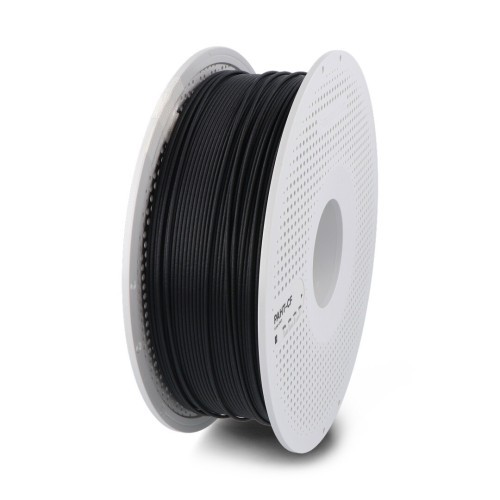
nylon-01.jpg— PRIMARY exact-product shot: Bambu Lab PAHT-CF 1.75 mm 1 kg black spool (retailer product photo, anodas.lt). Image nylon-01nylon-02.jpg— Bambu Lab PAHT-CF product/spool imagery (marketplace listing photo, shopee CDN). Slight variant: reseller photo rather than official render.nylon-03.jpg— Example application: custom 3D-printed gears in nylon/CF (Etsy seller product photo).- Discovery via
/opt/hatch/bin/image-search("Bambu Lab PAHT-CF spool black 1kg", "nylon 3D printed gears carbon fiber"); all URLs verified 200 + image/* via curl HEAD before download; converted to JPEG q90 with PIL. - Swaps noted: initial picks
shop.3dherndon.com/.../PAHT-CF (with spool)-1.pngandfusion3design.com/.../CF-Gear-Hero-1-sm-1.jpgboth returned 404 on HEAD check → replaced with the shopee PAHT-CF photo and the Etsy nylon-gears photo respectively.
Deepening pass (2026-09-20)
Social pulse (Facebook first)
- Failed source, substituted: the "nylon" keyword query returned zero posts in both the Engineering Filament Lab and the 17k-member "3D Printing" group (2026-09-20); the Siraya Tech Filament Users group also returned nothing for nylon. Substituted with forum threads, an independent test lab (CNC Kitchen), and a trade comparison — noted here.
Forums
- Prusa forum (CF-nylon printing help): the E3D v6 on the MK3 is already an all-metal hotend — the only required upgrade for CF nylon is a hardened steel nozzle (Nozzle X or ruby/sapphire as alternatives), since chopped fibers wear brass quickly. Bed adhesion: nylon won't stick to bare PEI — PVA glue stick on PEI works but needs refreshing between prints; a garolite bed adheres to nylon well even uncoated. And the moisture warning is blunt: PA6/6.6-copolymer filaments absorb moisture fast enough that even a fresh-out-of-the-box spool can clog the extruder — drying fixes it, but don't assume a sealed spool is a dry spool.
Independent testing (CNC Kitchen — PA6 vs PA12)
- Moisture conditioning results: after humid conditioning, PA6 samples reached about 3% moisture versus 0.7% for PA12 — a ~4× difference that shows up directly in mechanical behavior. The test's governing insight: filament must be perfectly dry to print, but the finished part then gradually reabsorbs moisture from the air and changes properties — something most owners overlook. Design for the conditioned state, not the as-printed state.
- Annealing angle: the test also conditioned annealed coupons, since annealing is a major topic in PA — heat treatment changes crystallinity and therefore the moisture/property relationship. Worth knowing before dismissing a "weak" nylon part that was never annealed.
Trade comparison (PA6 vs PA11 vs PA12)
- A 2026 trade guide tabulated the family: PA6 — highest moisture absorption (~3%), most warp-prone, most rigid, cheapest, hardest to print; PA11 — bio-based (castor oil), low-moderate moisture (~1–1.5%), excellent impact, most expensive; PA12 — lowest moisture (~0.5–1.5%), easiest to print, excellent dimensional stability, less stiff than PA6, mid-priced. For FDM specifically: PA6 = strongest but fussiest; PA12 = the forgiving default; PA11 = premium impact/chemical resistance (Prusament PA11-CF lives here).
- Practical read: the file's existing preference for PA12-based grades (PAHT-CF, NylonX) over PA6 is confirmed from three independent directions now — Bambu's wet/dry data, CNC Kitchen's conditioning test, and the trade guide.
Failure modes and fixes (new this pass)
- Wet-out-of-the-box: dry every nylon spool before first use regardless of packaging — fresh spools can already carry enough moisture to clog.
- Property drift after printing: parts reabsorb moisture in service; PA6 parts change more than PA12 — choose the base polymer for the part's life, not just the print.
- Bed adhesion: garolite or glue-stick-on-PEI; bare PEI won't hold nylon.
- Nozzle wear on filled grades: hardened steel minimum; 0.6 mm recommended for CF grades.
Price verification (2026-09-20, dated)
- Restated from this file's dated ladder: Polymaker Fiberon PA6-CF20 ~$40–53/kg (wholesale $39.99, MSRP $52.99 sold out) < Xtellar 645 $60/kg < Bambu PAHT-CF $94.99/kg < NylonX ~$121–126/kg < Prusament PA11 ~$125–153/kg. All observations dated 2026-09-20 in the file.
Deepening pass 3 (2026-09-21)
Facebook status update
- The
groups posts --group-id <id> --query "nylon"endpoint is not fully broken: in Engineering Filament Lab (id 26920098891014093) it returned 2 real nylon threads (2026-09-17, 2026-09-20) on 2026-09-21. Zero results in "3D Printing" (17k), "3D Printing World" (10k), Siraya Tech Filament Users (437), Overture 3D Filament (2k), and "3D Printing Filament, Materials And Tools" (18k) for nylon/TPU/polycarbonate queries — either genuinely quiet or the endpoint is flaky per group. No-verbatim rule respected: all facts below are summarized, never pasted.
Warping fixes from owner threads (FB Engineering Filament Lab, Sept 2026)
- Kingroon unfilled nylon on Snapmaker U1 / Bambu P1S (2026-09-20, 10 comments): owner warping on small ~3 cm parts without a chamber heater; printing 280 °C, fans off, 15–30 mm/s from a heated enclosure, 100 °C bed, tried Biqu Glacier / Bambu smooth and textured PEI with glue stick and Aqua Net. Best combo found: P1S + smooth plate + glue stick, but edges still curled even with a wide brim. Design-side attempts: internal cutouts, wavy walls, 15 mm brim with 0 gap, gyroid infill — fitment still suffered.
- Owner fixes (comments): Kingroon PA-CF on P1S owner — dry to ≤15% RH before printing, preheat the bed 30–40 min at 100 °C, Elmer's purple glue stick on the stock PET plate, Bambu PA-CF profile with bed temp dropped to 65 °C, plus brim (residual minor warping, not eliminated). P2S owner with Wham Bam plate + chamber heater at 65 °C + wide brims: nylon still occasionally warps despite the full setup. Another: elephant-foot compensation 0, hairspray, 35–40 °C chamber enough, 60 °C bed enough — but geometry is the dominant variable; higher infill makes bed-holding nearly impossible. Sunlu EasyPA unfilled: warping even on H2S with heated chamber; Vision Miner Nanopolymer adhesive + textured bed eliminated warping even without a brim. Suggestion: raise bed to 110 °C + Bambu liquid glue.
- Darkmoon CFX/Satin Duo build plate question (2026-09-17, 26 comments): owner bought Darkmoon CFX to cut adhesive time for nylons (filled + unfilled), couldn't get consistent adhesive-free prints.
- Adhesive consensus (comments): several owners use Darkmoon CFX as their go-to plate with Vision Miner nano polymer adhesive applied once, then isopropyl alcohol between prints — adhesion lasts many prints; nano-polymer + smooth PEI takes 10–15 s to apply with a foam brush and holds 10+ prints. No truly glue-free engineering plate exists — one owner's verdict: adhesive is cheap insurance vs. a failed print on expensive filament. Darkmoon G10 failure report: one owner had good results until washing the G10, after which it was never reliable again without glue despite the owner's help. BIQU Glacier PRO failure report: plate bubbling after ~2 months — owner went through 4 plates, switched to KDEAVI Soft Touch plate (no glue for PA12 or PA6, a few hundred hours on 2 machines, Amazon link shared — link not verified). Bambu engineering plate + Creality glue stick also vouched for; one owner considering DIY 0.5 mm G10 bonded with 3M heat-resistant tape.
New failure modes + brand signals
- Polymaker Fiberon PA612-CF15 (EFL, 2026-09-17, 8 comments): owner with poor top surfaces despite 10 days of drying at 100–104 °C. Comments: looks like over-extrusion — restart from temp tower + flow calibration; overdrying is possible — 10 days at 100 °C is excessive; one owner stopped using PA612-CF15 because the recent batch is bad (email confirmation from vendor claimed), after previously printing 30+ kg of it without issues — batch-variance signal, treat as single-source. Another owner runs 275 °C nozzle, 0.94 flow ratio, and considers 75 mm/s max volumetric speed too fast for this filament. Takeaway: PA612-CF is not the forgiving PA12CF some marketing implies; batch variance + overdrying both bite.
- PA612-CF15 split reviews (desertcart, 2026): one 5-star review calls it a go-to with no warping for airsoft/RC/boat parts on a Qidi Plus 4; one mediocre review reports a notch in the filament that caused a 20 h print to fail mid-print and cardboard spools with inconsistent diameter racking in the AMS — his verdict: half the price of Bambu CF filaments, buy at your own risk. Spools: 500 g format confirmed (Polyfab3D listing, 4/5 stars, 2025 review).
Long-term / conditioning evidence (web, Sept 2026)
- Qidi print-lab blog (crawled 2026-09-21): nylon saturates in as little as 18 h of ambient exposure; CNC Kitchen's conditioning showed PA6-CF dropping to 56% of its dry tensile strength after moisture conditioning — the strongest single number on why drying discipline determines part life. PAHT-CF water absorption 1.37% vs PPS-CF 0.05%. Dry 70–80 °C / 6–12 h before use, print from an enclosed dry box. PET-CF noted as the less moisture-fussy alternative for those without a dry box.
- Polymaker Fiberon official comparison table (Amazon listing, crawled 2026-09-21): HDT (0.45 MPa) — PA12-CF10 131 °C, PA6-CF20 215 °C, PA612-CF15 175 °C, PA6-GF25 191 °C; XY modulus — PA6-CF20 8636.5 MPa, PA612-CF15 5136.7 MPa, PA12-CF10 3311.2 MPa; Z-tensile — PA6-GF25 60.7, PA6-CF20 54.0, PA12-CF10 52.2, PA612-CF15 48.3 MPa; drying for all: 100 °C / 10 h; chamber temp listed as "room temperature" for all four.
- 3dtechvalley nylon comparison (crawled 2026-09-20): PA6 — highest moisture, most warp-prone, hardest; PA12 — low-medium moisture, medium difficulty; PA6-CF — medium-high moisture, medium-hard; PA12-CF — low-medium moisture, very low warp, medium difficulty (confirms this file's PA12-over-PA6 preference).
Pricing (dated 2026-09-21, USD unless noted)
- Filamatrix (crawled 3 days prior): Nylon Kevlar from $34.99, Nylon Glass Fiber from $49.99, Nylon Carbon Fiber from $54.99, Nylon CF 2.2 kg $199.99, PAHT-CF hydrophobic from $74.99, PAHT hydrophobic from $49.99 — the cheapest CF-nylon ladder in the survey, all on sale pricing.
- Ultimate3DPrintingStore (crawled 4 days prior): Bambu Lab PA6-CF $79.99, Bambu PPA-CF (0.75 kg) $149.99 sold out, MakerBot Nylon 12 CF $129.00, BASF Ultrafuse PA natural $58.95, Luvocom PAHT 9825 NT $113.00 sold out.
- Overture Easy Nylon (official page, crawled ~153 days prior — stale): $33.99 (was $37.99), 1 kg, copolymer PA6/6.6, dry 95 °C / 7 h, enclosed printer required, PVA glue recommended.
- EU datapoint — 123-3D (crawled ~305 days prior — stale): eSUN ePA12-CF 1 kg €99.50 incl. VAT; PA12-CF15 own-brand €94.50.
- 3dprinting.com composite table (article 92 days old, crawled 2026-09-21): PA6+CF ~$55–65/kg (no enclosure), Bambu PA6+CF ~$35–45/kg, value PA+CF ~$35–45/kg, PC+CF ~$80–100/kg, ASA+8%CF ~$40/500g spool, PETG+20%CF ~$60–75/kg, Bambu PETG+CF ~$30–38/kg.
- Dated-price caveat: stale crawls are noted above; none are quoted as current retail.
Sources
- store.thinglab.com.au — retrieval date not recorded
- buildvolume.co.za — retrieval date not recorded
- crea3d.com — retrieval date not recorded
- 3dexpress.my — retrieval date not recorded
- us.store.bambulab.com — retrieval date not recorded
- shop.3dherndon.com — retrieval date not recorded
- shop3duniverse.com — retrieval date not recorded
- smith3d.com — retrieval date not recorded
- shop.app — retrieval date not recorded
- shop.polymaker.com — retrieval date not recorded
- us-wholesale.polymaker.com — retrieval date not recorded
- fiberon.polymaker.com — retrieval date not recorded
- polymaker.com — retrieval date not recorded
- matterhackers.com — retrieval date not recorded
- matterhackers.com — retrieval date not recorded
- matterhackers.com — retrieval date not recorded
- matterhackers.com — retrieval date not recorded
- facfox.com — retrieval date not recorded
- blog.prusa3d.com — retrieval date not recorded
- blog.prusa3d.com — retrieval date not recorded
- proforged3d.com.au — retrieval date not recorded