ABS
Published · Researched 2026-09-21
ABS is the budget styrenic: same heat tolerance and acetone-smoothable finish as its famous cousin ASA, minus the UV resistance, at about five bucks less per kilo. That's the whole pitch, and per a 31-comment debate in the Engineering Filament Lab group this week, it's the only pitch keeping ABS alive.
The material itself needs little introduction. ABS is the classic RepRap-era engineering plastic: usable around 90–100 °C (glass transition at 101 °C per Polymaker's TDS), ductile enough to bend instead of snap, and the one filament you can dissolve into a glass-smooth surface with an acetone vapor bath. Voron's materials guide still names it the primary recommended material for Voron builds. Tensile strength sits around 33 MPa on Polymaker's PolyLite TDS — nothing heroic, but paired with real impact resistance it's the combination that matters: parts that survive drops, heat, and fasteners.
What's genuinely good is how settled ABS is. Nobody is discovering ABS in 2026; they're just printing it. Styrenics barely absorb water, so there's no dry-box ritual — an occasional 70 °C drying cycle handles it. Acetone vapor smoothing remains unmatched for display parts and mold masters: multiple FB commenters this week noted ABS responds to acetone faster and easier than ASA does, which is why paint-and-finish people keep a roll around. And for indoor functional parts, owners consistently report that it's forgiving in the ways that count — one commenter described it as having a bit of flex, "kinda petg ish," versus ASA's snappier rigidity. The RC crowd is the clearest use case in the wild: "I print a lot of RC stuff out of abs, since it doesn't stay outside it's fine." Cheap, tough enough, no sun — ABS earns its shelf space there.
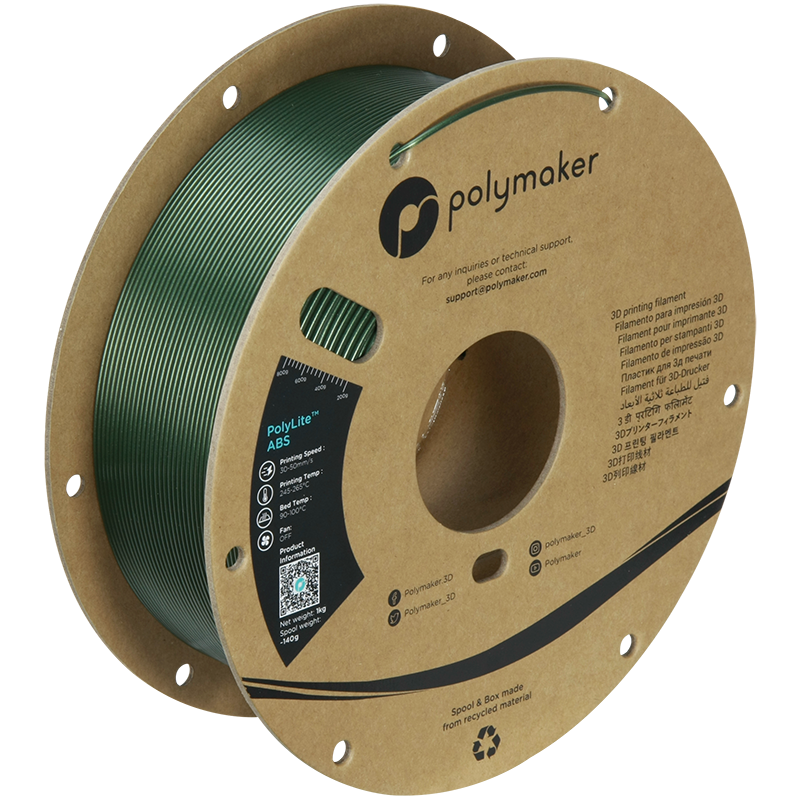
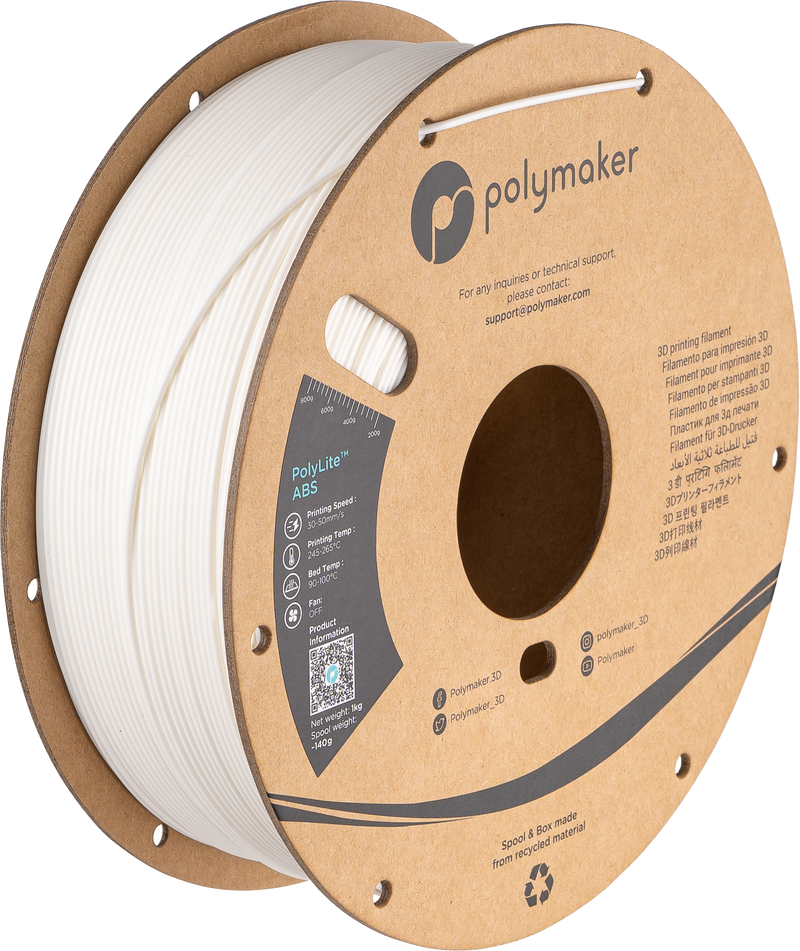
Brand-wise, the community has a working taxonomy. Polymaker's PolyLite ABS at $19.99/kg (verified live, Sept 2026) is the reference spool — consistent, AMS-friendly, cheap enough to iterate with. Bambu's ABS at $35.99 is the ecosystem tax: RFID profiles, premium price. Then the value tier — eSun, Hatchbox, Overture — gets what one reviewer called the "ABS is ABS" shrug: perfectly usable, more spool-to-spool variance. The deepening pass added texture here. A reprap.org veteran notes that modern ABS filament is much less prone to warping than it was in the past — the material has quietly improved — and singles out Extrudr ABS for good results. Meanwhile eSun ABS+ "practically does not warp at all for me, it is problematic when it comes to bridging and overhangs." That's a brand-level tradeoff worth knowing: low-warp formulations pay for it in overhang quality.
What's actually wrong is everything about the conditions ABS demands, and this is where the review has to stay blunt. Without an enclosure, warping is brutal. The consensus: a heated bed alone doesn't cut it for anything beyond small parts — you want 45–60 °C of chamber heat, the Voron standard. Cooling fan off, drafts treated as the enemy, cheap formulations varying spool to spool. Then the honest gate: styrene. Melted ABS emits styrene and ethylbenzene VOCs plus ultrafine particles, and the maker conversation around this is the frankest health discussion in the filament world — people report headaches, nausea, and a persistent cough from unventilated printing. An enclosure keeps the smell in the room; it doesn't fix the chemistry. The working consensus is a recirculating activated-carbon filter (the Voron community's Nevermore builds) or ducting exhaust outdoors — and venting outdoors dumps your chamber heat, which is exactly what fights warping. One FB member picked PETG-CF for a robot-arm build this week specifically because they "don't have proper ventilation for abs/asa." That's the entire debate in one sentence.
The deepening pass added a cost nobody prices in: carbon filters saturate. A Bambu forum regular puts it plainly — "Neither an enclosure nor a HEPA filter will help for VOCs... You need an activated carbon filter for those. That filter will saturate after some printing, so you have to exchange it regularly." Filtration isn't a one-time purchase; it's a consumable line item, and an air-quality monitor is the honest way to know when the filter is spent. Two more gotchas from the second pass: thick walls plus high-density infill make styrenics curl and pop build-plate corners even when thin parts print beautifully — the fix is thinner shells and lower infill, not more heat. And ABS yellows, chalks, and embrittles in UV — indoor filament, full stop. The "+" variants are a documented trap: Voron explicitly warns ABS+ formulations can have glass transitions as low as ~75 °C, which quietly erases the heat tolerance you bought ABS for. Also: glue stick on PEI is a release agent, not an adhesion aid — ABS bonds so aggressively to bare PEI it can rip the coating off on removal.
The social pulse this week was the ABS-vs-ASA thread, and it's clarifying because nobody defends ABS on merit. The thread's shape: ASA wins UV resistance, warps a bit less, finishes matte and nicer; ABS wins on price, color range ("ABS if you intend to paint it"), faster acetone smoothing, and a touch more flex. "When you really get down to brass tacks," wrote the thread's most thorough commenter, "if you're not using the part outdoors... there's not always a reason to spend the extra money on ASA." But the direction of travel is obvious: several regulars said they'd drop ABS entirely if ASA ever hit ~$10/kg, and one claimed Elegoo ASA already touches ~$11/kg in bulk (unverified anecdote, but the price pressure is real). The lurking third candidate is PCTG — "If it were the same price as ABS, I'd never use ABS again," wrote one member, with others nodding along. ABS isn't loved. It's tolerated as the cheap indoor option while the gap closes.
Value call, Sept 2026: Polymaker PolyLite ABS at $19.99/kg (fresh, direct) is the sane default. MatterHackers' Build line advertises bulk tiers down toward $16/kg (slightly stale listing — treat as approximate). Bambu at $35.99 is hard to justify unless you're deep in that ecosystem. Prusament ABS pricing couldn't be verified this round, so don't quote a number. And note the Bambu-forum bulk anecdote from December: heavy buyers paying ~$14–18/spool for ABS vs $18–26 for ASA when buying 40–50 rolls on sale — consistent with the ~$5/kg ABS discount in the table, and a reminder that at volume the gap is real money. The internal comparison is the one that matters: ABS is the cheaper indoor sibling of ASA ($24.49–26.99/kg for PolyLite ASA). Part stays inside — ABS. Part sees the sky — ASA.
Skip it if: no enclosure, no ventilation plan, or the part lives outdoors. For the first two, PETG is the answer. For the third, ASA.
Buy the enclosure and the ventilation first. The filament is the cheap part — until you price in the filters.
Sources
- facebook.com — retrieval date not recorded
- shop.polymaker.com — retrieval date not recorded
- us-wholesale.polymaker.com — retrieval date not recorded