ASA
Published · Researched 2026-09-21
Here's the honest question from this week's busiest filament thread: if ASA matches ABS on everything and survives sunlight, why does anyone still buy ABS? The 31-comment answer from the Engineering Filament Lab group: price, and not much else. ASA is the better styrenic. It just costs more — for now.
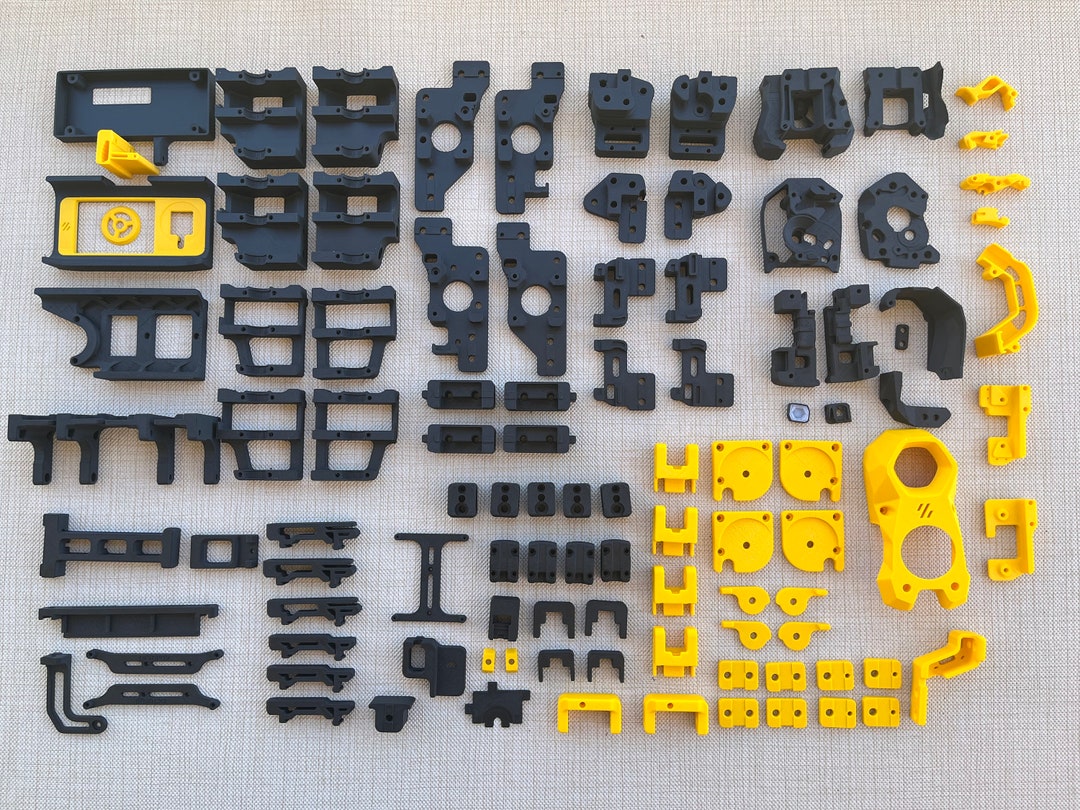
The chemistry is one swap. ASA keeps ABS's acrylonitrile and styrene but replaces the UV-vulnerable polybutadiene rubber phase with an acrylic elastomer that doesn't care about sunlight. The automotive industry built it for exterior trim that has to survive 5–10 years of sun, and that pedigree transfers directly: sensor housings, garden brackets, car parts, drone shells — everything that would yellow, chalk, and embrittle in ABS. Polymaker's FAQ calls it "almost exactly the same as ABS with 1 major difference," weather resistance, "and 1 minor difference," a matte finish that hides layer lines. The aging data backs it: two years of natural weathering with color shift under ΔE 2.5, and 8000 kJ/m² of accelerated UV with minimal tensile loss, in exposure that degrades ABS. Voron's materials guide lists ABS as the primary recommendation but states ASA is "fully supported as well due to the very similar technical properties" — and the Voron community has made it the default anyway. Complete Voron parts kits ship printed in ASA. There's a self-reinforcing loop at work: you need an enclosed, heat-soaking printer to print ASA, which is exactly what a Voron is, so Voron owners print Voron parts in ASA.
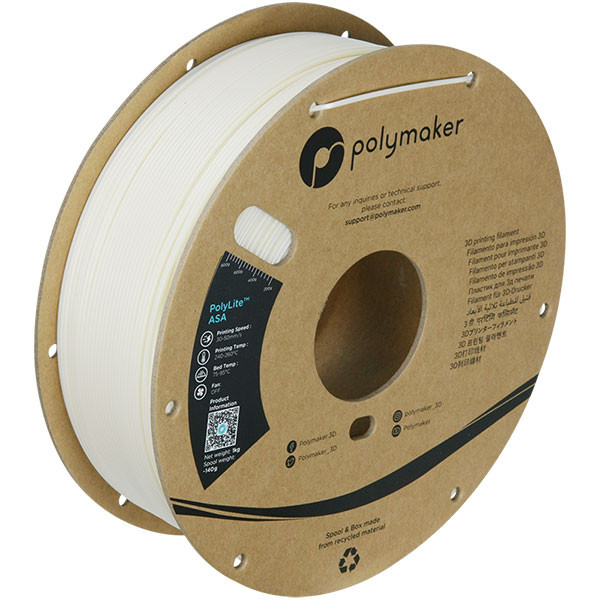
What's genuinely good starts with the thing ABS can't do: live outside. MatterHackers calls it the #1 outdoor filament, and nobody in the community disputes the title. The matte finish is a genuine cosmetic upgrade over ABS gloss — functional parts look finished rather than shiny-prototype. Mechanically it prints like ABS and behaves like it, so everything you know transfers: similar stiffness, similar heat tolerance around 100 °C, acetone-smoothable. And here's where the value story got interesting this year: Polymaker's PolyLite ASA at $24.49–26.99/kg (verified live on their US store, Sept 2026) has become the reference spool the whole category gets judged against. One FB commenter this week claimed Elegoo ASA dips to ~$11/kg at times and in bulk — that one's unverified, treat it as an anecdote — but the direction is clear: ASA's premium over ABS is compressing, and several regulars said they'd abandon ABS entirely if ASA hit ~$10/kg.
The brand landscape has an authority worth naming: MyTechFun's "What is the best ASA filament? 10 different ASA brands tested" puts Sunlu, BambuLab, Polymaker, AzureFilm ASA Prime, Prusament, 3DO, FlashForge, eSun eASA, Qidi, and Formfutura Apollo X through tensile, layer adhesion, warping, creep, temperature, and impact testing. Results are video-only (no text summary retrievable), but the roster matters — it's the test the community cites instead of arguing from anecdotes. On the forums, preferred brands keep recurring: PolyLite, FlashForge, and Inland ASA on the Bambu forums, with Formfutura's ApolloX getting a mixed report (more below).
What's actually wrong is the same list as ABS, because ASA is ABS with a sunscreen. It warps like ABS, smells like ABS, and demands the same enclosure and fume management: 45–60 °C chamber, cooling fan off, brim or skirt, no drafts. Polymaker's product page just says "Enclosure Needed," full stop. And the deepening pass turned up evidence that the enclosure alone doesn't settle it. A Bambu forum owner with three X1Es — flagship enclosed machines — reported warping "like crazy" with both Formfutura ApolloX ASA and Bambu's own ASA, despite slow speeds and massive brims: "I thought at least the Bambu filament should work with a Bambu (higher end) printer and Bambu profiles." First-party filament on a first-party printer, still warping. That should calibrate expectations: ASA warping is a material property, not a settings failure.
Design matters as much as settings. A Bambu forum regular documented the pattern precisely: thick walls plus high-density infill made an ASA part curl and pop a build-plate corner — while a thin-shell part in the same material came out "gorgeous." ASA likes thin and delicate; it punishes chunky. The fixes are design-side (thinner shells, lower infill) plus the usual 40–45 °C chamber preheat. Brand quirks exist too: ASA Aero, the foaming lightweight variant, is extremely sensitive to the nozzle-temp/flow-rate combination because of its blowing agent — get the profile wrong and it fails immediately. And moisture, while low for styrenics, still bites problem spools; drying is the first thing to try when a known-good roll misbehaves.
The fume burden is identical styrene-class chemistry, and the community is admirably frank about it. A Voron owner documented visible white "ASA fog" — actual deposited emissions — coating the inside of the enclosure's acrylic panels after heavy ASA printing. The Bambu forum's reality check from the deepening pass deserves quoting in spirit: "Neither an enclosure nor a HEPA filter will help for VOCs which are the main danger of ASA and ABS. You need an activated carbon filter for those. That filter will saturate after some printing, so you have to exchange it regularly." Two honest costs in there: filtration is a consumable, not a one-time purchase, and an air-quality monitor is the only way to know when the filter is spent. Never a bedroom, with or without a filter.
Two smaller findings from the second pass. First, the September blowtorch test of eight filaments: ASA ignited immediately, burned vigorously, and kept burning after the torch was removed — the worst of the set, while flame-retardant ABS V0 self-extinguished. Don't spec ASA near heat sources without thinking twice. Second, the palette: ASA's natural pellet color is off-white rather than transparent or white, so vivid brights are rarer than in ABS — "ABS if you intend to paint it" was the thread's verdict, and ASA buyers wanting strong colors should check the specific brand's range. It also bonds aggressively to PEI, so glue stick as a release layer is part of the workflow.
The social pulse is the quiet displacement story with a challenger on the horizon. In the Voron/functional world, ASA has pushed ABS aside as the default serious filament — settled, not hypey. But the FB thread's undercurrent is that ASA's crown is conditional: it's the rational outdoor choice, defended on UV data and attacked on price, and PCTG keeps getting named as the material people would pick instead if the price were equal. "If it were the same price as ABS, I'd never use ABS again, and only use ASA when I need REALLY high levels of UV resistance." ASA is respected, not loved — an engineering material the community treats as infrastructure.
Value call, Sept 2026: Polymaker PolyLite ASA at $24.49–26.99/kg (live, direct, by color) is the buy — the price everything else gets judged against. MatterHackers' Build line at $29.99 ($22.49 in bulk) is the budget play with US retailer support. Prusament ASA is $25.92 per 800 g spool — do the math, that's $32.40/kg equivalent, so compare carefully. Bambu ASA at $46.99 is ~1.8× the PolyLite price for RFID ecosystem convenience; the EU picture is worse, with PolyLite ASA at €36.50–37.50/kg through 123-3d.ie. Skip the foaming ASA Aero at $64.99 unless you specifically want lightweight parts — different product class, different failure modes.
Skip it if: you don't own an enclosure, or the part never sees daylight. Open-printer owners go PETG; indoor-only functional parts go ABS — while the price gap lasts.
Same warping, same fumes, plus sunlight. The better styrenic, at a price the market is still negotiating.
Sources
- 123-3d.co.uk — retrieval date not recorded
- i.etsystatic.com — retrieval date not recorded
- i.ebayimg.com — retrieval date not recorded