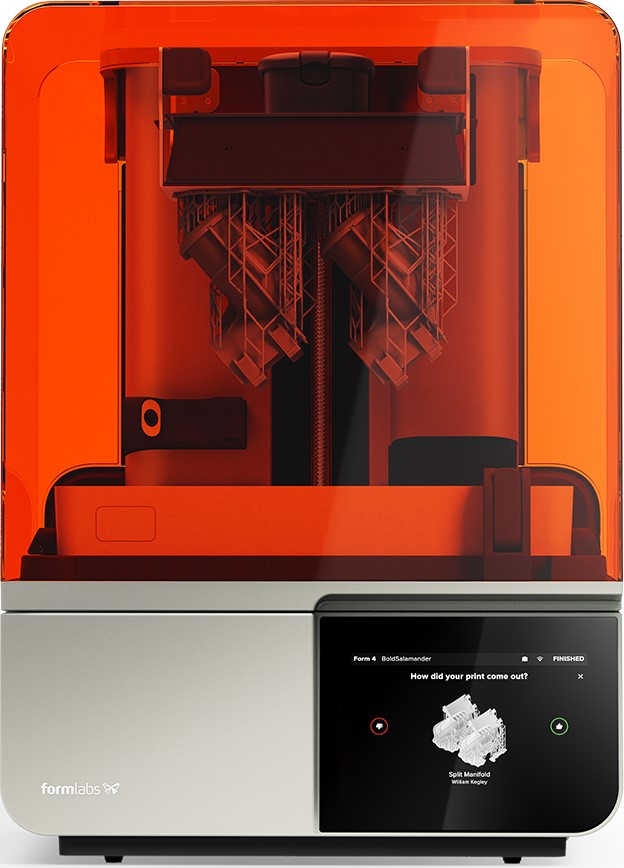
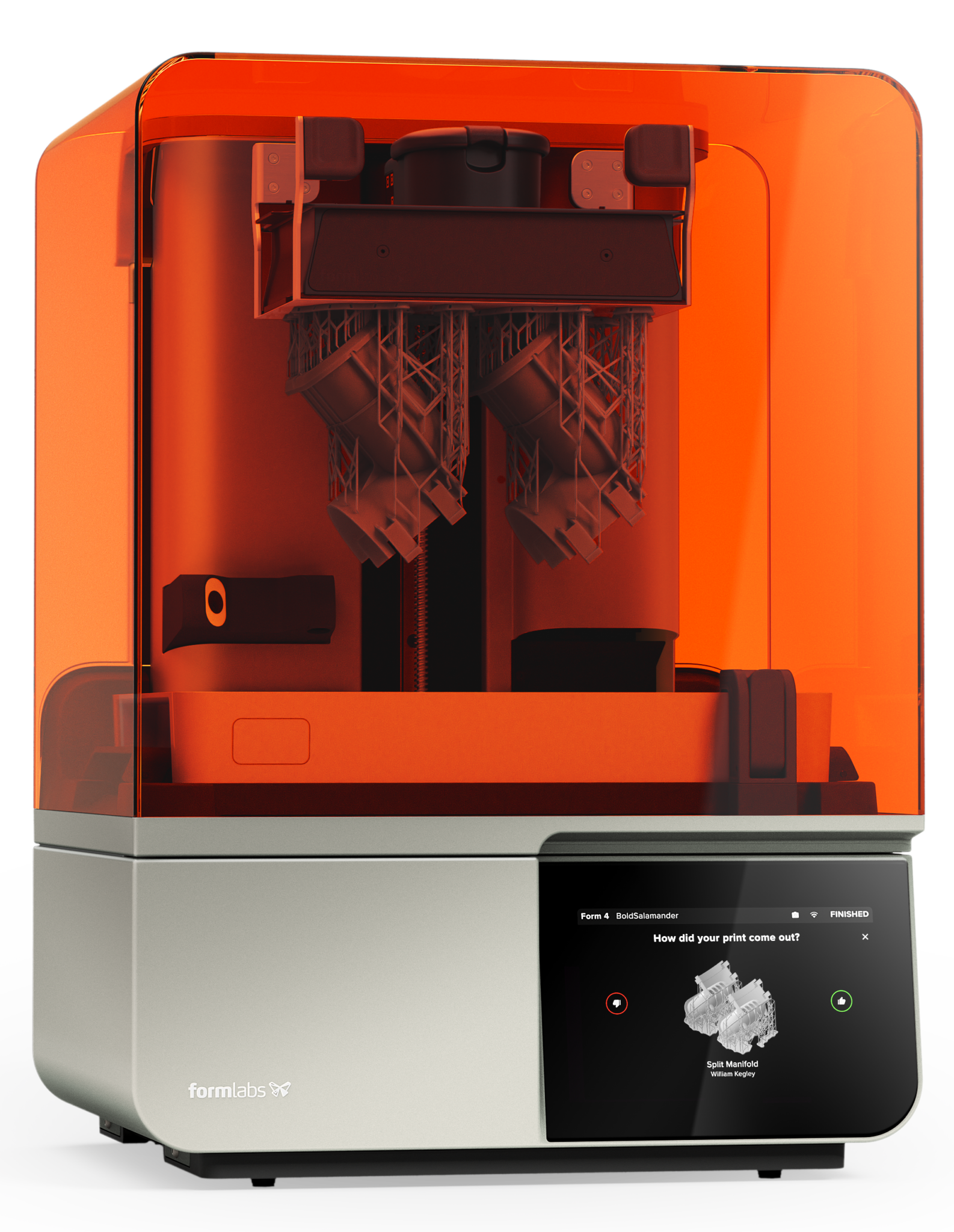
Formlabs Form 4
Published · Researched 2026-09-21
The Form 4 is the printer you buy when a failed print costs more than the printer. It's Formlabs' current professional resin machine — launched April 2024, still flagship in 2026 — and it wins on the only spec that matters at work: the print being done, correct, and on time.
The technology is a pivot: Formlabs abandoned its laser-based LFS system for Low Force Display — 60 high-power LEDs shining through an LCD mask, curing a whole layer at once. The tradeoff is right there on the spec sheet: 50 µm native pixels versus the old Form 3's 25 µm laser spot, mitigated with pre-tuned sub-pixel anti-aliasing. The payoff is speed — up to 100 mm/hr, most prints done in under two hours — and lower cost per part. The 2026 lineup also includes the Form 4B (biocompatible/medical material library), the Form 4L (large-format, launched November 2025, from $7,125), and the older laser-based Form 3 generation, which is still sold.
What's genuinely good: reliability, to a degree the hobby machines can't touch. Tom's Hardware's Denise Bertacchi called it "a great tool for businesses who need perfect parts... don't have time to waste on tinkering." TechRadar gave it 5/5 for reliability and ease. Formlabs' own white paper claims a 98.7% success rate across 225 prints against 13.8–25.3% failure rates for the benchmarks — vendor-commissioned, so take the exact numbers with salt, but the direction matches every independent reviewer. The workflow is the product: automatic resin dispensing from 1 L cartridges, a resin mixer with debris sensor, level and temperature sensors, auto-heating to 25–45 °C per material, tank-life tracking (75,000+ layers), Wi-Fi/Ethernet/USB-C, PreForm software that auto-orients and auto-supports, and a guided touchscreen interface built to prevent operator error. Serviceability is a real strength — the machine is designed for owner part replacement with the included toolkit, and a 2026 reviewer found replacement components reasonably priced. Support reputation is genuinely strong: Formlabs staff engage on the community forum and open tickets for users proactively, and reviewers describe fast replacement-part shipping. The wash and cure stations are excellent — this is the part of the workflow hobby machines cheap out on. And the material library is 20+ deep: General Purpose V5, Tough 1500/2000, Rigid 4000/10K, Elastic, Flexible, Castable Wax, High Temp, ESD, flame retardant, silicone — specialist materials that don't exist in the budget resin world.
What's actually wrong: the ecosystem was a velvet cage, and the 2026 opening of it is both real and confusing. Tom's Hardware's only cons were "expensive" and "must use Formlabs materials," and Hacker News owners kept doing the math against Elegoo resin prices — because Formlabs resins historically ran $149–$250+/L while Elegoo's run $30. The Developer Platform (announced November 2025) answered the community's loudest complaint: Open Material Mode for third-party 405 nm resins, a free Print Settings Editor, third-party API integrations, General Purpose resins at $79/L, and bulk SLA resin at $35/L for high-volume buyers. But the license price is genuinely unresolved — Tom's Hardware cites $2,499 for the third-party material unlock while 3dtechvalley's updated 2026 review cites **$875** one-time. Those cannot both be current. Do not budget either figure without re-verifying at purchase.
The tank economics deserve their own paragraph, because they're the running-cost question nobody puts on the product page. The tanks use non-user-replaceable film — the whole tank is the consumable — and the mixing arm is a separate item; Develop3D cited £99 + VAT combined at publication. Tank replacement cost is unpublished and varies by retailer. At 75,000+ layers per tank the cadence is slow, but budget it as a real line item, not a footnote.
Other caveats survive the ecosystem opening. Post-processing is effectively mandatory — the Wash Gen 2 and Cure Gen 2 you actually want push the Basic package ($3,499: printer, tank, mixer, finish kit, build platform) toward the Complete package at $6,589, and filling the wash costs ~$50 in IPA. Form Auto doesn't work with the Form 4, so there's no automated part-removal for 24/7 production. The 50 µm pixel is coarser than the old laser generation — fine for engineering parts, a step back for anyone chasing the finest detail. FauxHammer's verdict is the clearest framing on record: "brilliant, expensive, and almost certainly not for miniatures" — limited support tools for fine detail, mixed results with pre-supported miniatures. Tom's Hardware adds practical complaints: louder than many resin machines, and no USB-drive workflow (USB-C only). The camera can be disabled, physically covered, or removed — good, but note it exists.
Skip it if you're a hobbyist printing minis — an Elegoo does that at a tenth the price, and FauxHammer is explicit that this isn't the machine for it. Skip it if your parts are bigger than 200 × 125 × 210 mm — price the Form 4L first. Skip it if the tank/license economics don't clear your finance check; the printer is the down payment, the ecosystem is the mortgage.
The social pulse: professional, not passionate. The strongest voices are the Formlabs Community Forum, a Hacker News launch thread, and the pro review circuit — Facebook's group is admin-heavy with poor owner density, Threads returned noise, and Instagram was unsearchable in this pass, so there's no casual-owner sentiment to mine. The shape of the debate is consistent: reviewers and forum professionals call it near-failproof for business use; the HN crowd grumbles about resin economics. The Developer Platform announcement shifted the argument's terms — "must use Formlabs materials" became "may use Formlabs materials," which is a different sentence, even if the license price is still foggy.
Value call: from $2,625 MSRP, with the $3,499 Basic package the realistic floor and $6,589 the real-world production setup with wash and cure. That's roughly 7× a Saturn 4 Ultra — and for a business where a failed overnight print means a missed client deadline, it's still cheap. The Open Material Mode license pays for itself fast if you're running volume on third-party resin — at ~$30/L versus $79–$250/L — once you confirm which of the two published license prices is real. Against the older Form 3 generation it's faster and cheaper per part, with coarser detail; against the hobby machines it's a different universe of support and workflow, at a different universe of price.
The Form 4 doesn't win on specs. It wins on the print being done, correct, and on time — which is the only spec that matters at work.
Sources
- arkinfo.in — retrieval date not recorded
- applicadindonesia.com — retrieval date not recorded
- formlabs.com — retrieval date not recorded
- fauxhammer.com — retrieval date not recorded
- tomshardware.com — retrieval date not recorded
- develop3d.com — retrieval date not recorded
- store.proto3000.com — retrieval date not recorded