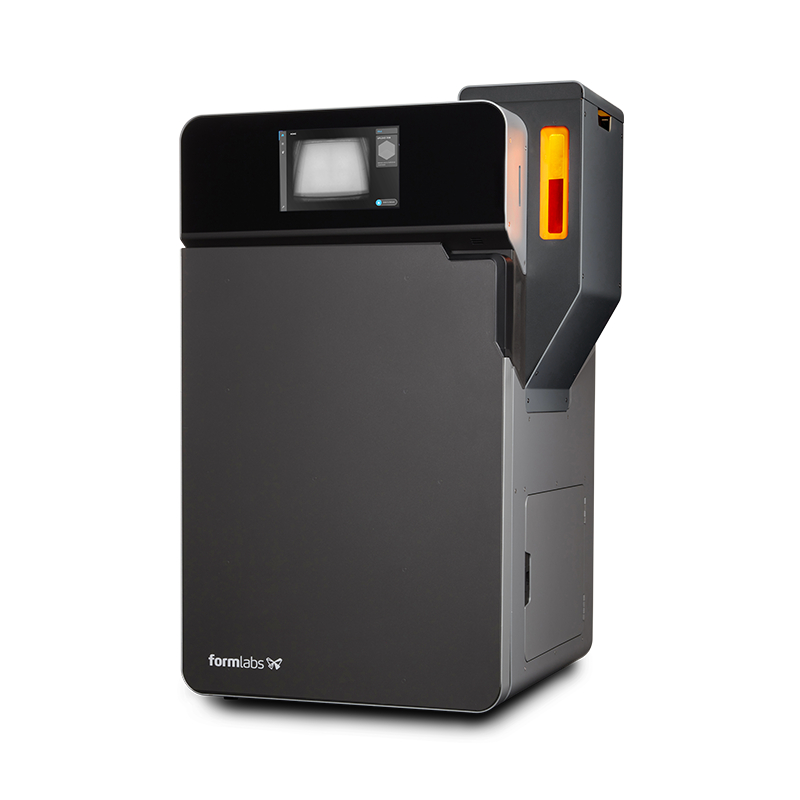
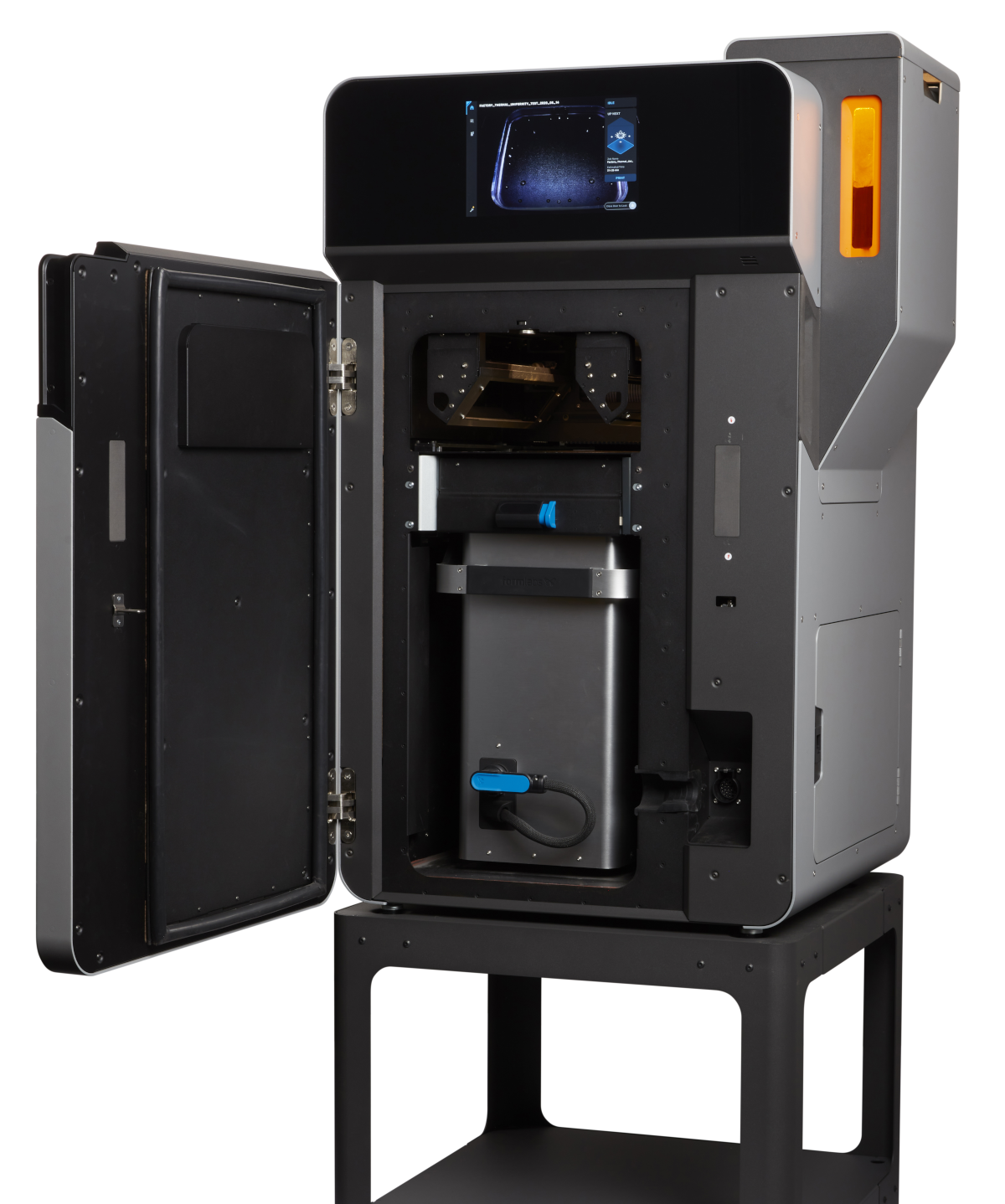
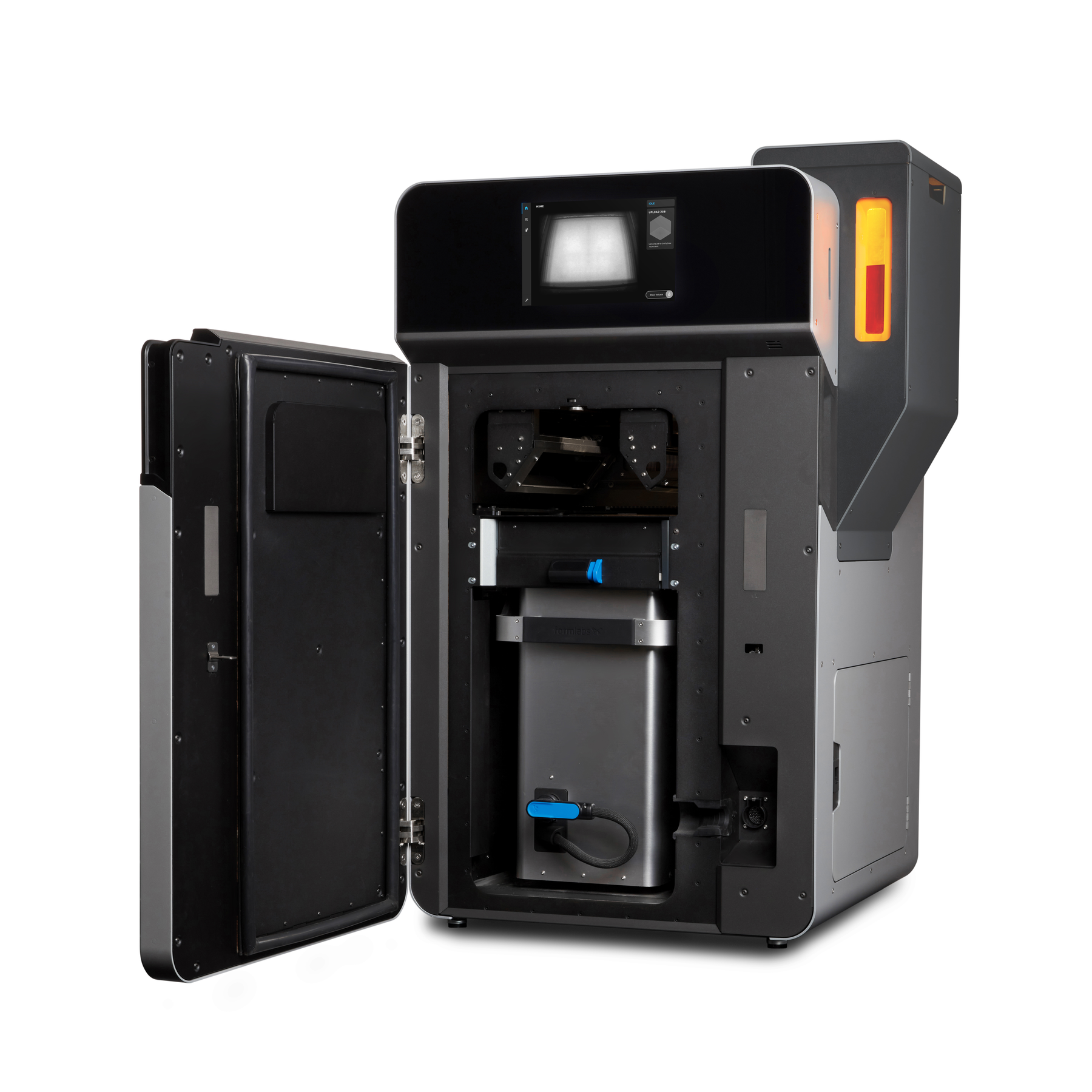
Formlabs Fuse 1+ 30W
Published · Researched 2026-09-21
The Fuse 1+ 30W is the cheapest credible way to own SLS — and "owning SLS" mostly means owning the powder, the cooldowns, and the cleanup.
Somewhere in a workshop, a heated chamber full of white nylon powder is cooling down, and inside it — packed like fossils in sediment — are a hundred finished parts that needed no supports, no rafts, nothing but a blast cabinet. That's selective laser sintering: a 30 W ytterbium fiber laser sinters nylon powder layer by layer in a ~200 °C chamber, and the unsintered powder supports everything, so complex geometries and dense part packing come free. Build volume 165 × 165 × 300 mm (8.2 L), 110 µm layers, 247 µm laser spot. Validated materials: Nylon 12 (the workhorse), Nylon 12 Tough, Nylon 12 White (biocompatible), Nylon 11, glass-filled 12, carbon-filled 11, TPU 90A, plus polypropylene — and since November 2025, Open Material Mode for any 1064 nm powder. Formlabs positions it at ~1/10th the cost of traditional industrial SLS. In 2026 it gained a bigger sibling, the Fuse X1 (330 × 330 × 565 mm, 61.5 L, AI Print Intelligence) — so the 1+ is now the entry point of the Fuse line, and anyone with bigger parts should price the X1 before committing.
What's genuinely good: reliability, the owner-reviewer kind. 3dprint.com's January 2026 review — written by someone with thousands of hours across Fuse 1+ units — calls it "one of the most reliable printers I have come across," with "zero parts replaced, zero downtime," "elite level" 24/7 consistency, and support that "far surpass[es] the competition" even against industrial SLS systems. Dense builds (>75% packing) ran at ~$1.15 per complex part in a 120-part batch with up to 70% recycled powder. Formlabs' forum staff are notably proactive — support opens tickets for users reporting failures — which matters when your machine costs as much as a car. The workflow is self-contained: modular swappable build chambers mean one prints while another gets extracted, and the Fuse Sift station handles extraction, sifting, recovery, and mixing in one box. No supports means geometries that FDM and resin simply can't do, and nitrogen inert-gas printing is available for better mechanical properties and lower refresh rates.
What's actually wrong: the money, the mess, the cooldown, and the size. The Starter package is $29,499 (printer, chamber, powder cartridge, manual depowdering kit, service plan) — and that's the starter. A realistic production setup with the Fuse Sift ($9,999, effectively required for any real volume — the $999 manual depowdering kit is the low-production alternative) and Fuse Blast ($10,999 + $2,699 polishing module) lands at $57,442 complete. One source frames it as ~$25k printer / ~$55k ecosystem; the numbers rhyme. Powder is the dominant running cost: Nylon 12 at $99/kg with a 30% fresh-powder refresh floor (bulk pricing from $45/kg helps at scale) — every build has a floor cost before the laser fires. And here's the part the brochure undersells: depowdering is real manual labor. The Formlabs forum's densest complaint cluster is the work the printer doesn't do — extraction, sifting, cleaning between builds, material changes, the cleaning-station design. "You really need a blasting cabinet to get the most of it," says one owner, and they're not selling blasting cabinets. Then there's cooldown: builds finish, then parts sit cooling in the chamber, and your throughput math has to include that dead time. Powder handling is inherently messy — PPE, respirators, and a powder-safe vacuum ($1,199, NFPA-652 compliant) aren't optional, and ESD-safe practices matter. The build volume is small for the money: 165 × 165 × 300 mm. The chamber needs a dedicated 120 VAC / 15 A circuit. Parts placed near the chamber door can show ~2% Z-scaling (a placement rule to learn once), and warmup "sintered band" failures are fixed by raising refresh to ~70% and thorough vacuuming between prints. And it's starting to feel dated — the same owner-reviewer who praised its reliability flagged the upcoming Raise3D RMS2200 as the thing to watch.
Skip it if your parts are bigger than a shoebox — price the Fuse X1 first. Skip it if you don't have a room for the powder workflow (printer + Sift + Blast is a room, not a desk), and skip it if you just need a few dozen nylon parts a year — a service bureau at $10–60 per small part will be cheaper, and you won't own the mess.
The social pulse: professional users and shop owners, plus one very thorough owner-reviewer — no casual hobbyist chatter exists because there's nothing casual about a $30k powder machine. The signal lives on the Formlabs forum and the 3dprint.com review; r/AdditiveManufacturing has some industrial-crowd presence but thin owner accounts, Facebook's group API returned nothing for Fuse queries, Threads was noise, and no genuine owner how-to video content surfaced. The shape of the debate: "most reliable low-hassle route into production SLS" versus "small, messy, and the powder bill never stops." The complaints are all about the workflow around the printer, never about the printing itself — which tells you where the engineering is done and where it isn't.
Value call: $29,499 starter, ~$55–57k realistic production setup, $24,649 reseller "starting at" for the printer package (the $24,999 Purple Platypus bundle including Sift + Blast looks implausibly low against individual accessory prices — treat with caution). Against industrial SLS at $250k–$1M+, it's a rounding error; against a bureau, you break even somewhere in the hundreds-of-parts-per-year range depending on packing density. The powder refresh math is the real TCO: at $99/kg and 30% minimum fresh, the machine is the down payment and the powder is the mortgage.
The most reliable way to own SLS — as long as you understand that the printer is the easy part.
Sources
- additive-x.com — retrieval date not recorded
- 3dprint.com — retrieval date not recorded
- formlabs.ib-caddy.com — retrieval date not recorded