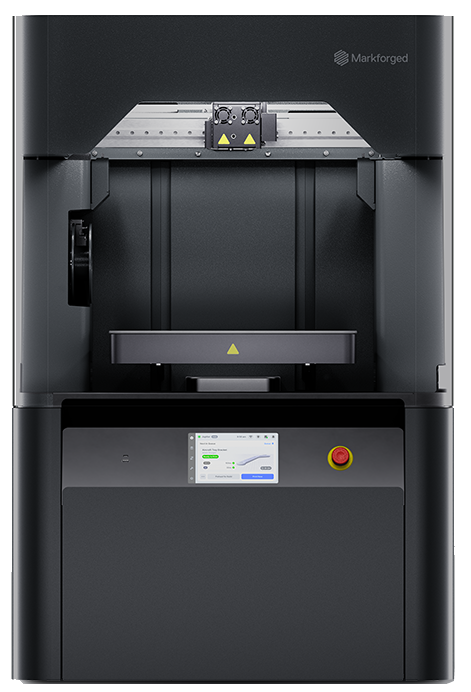
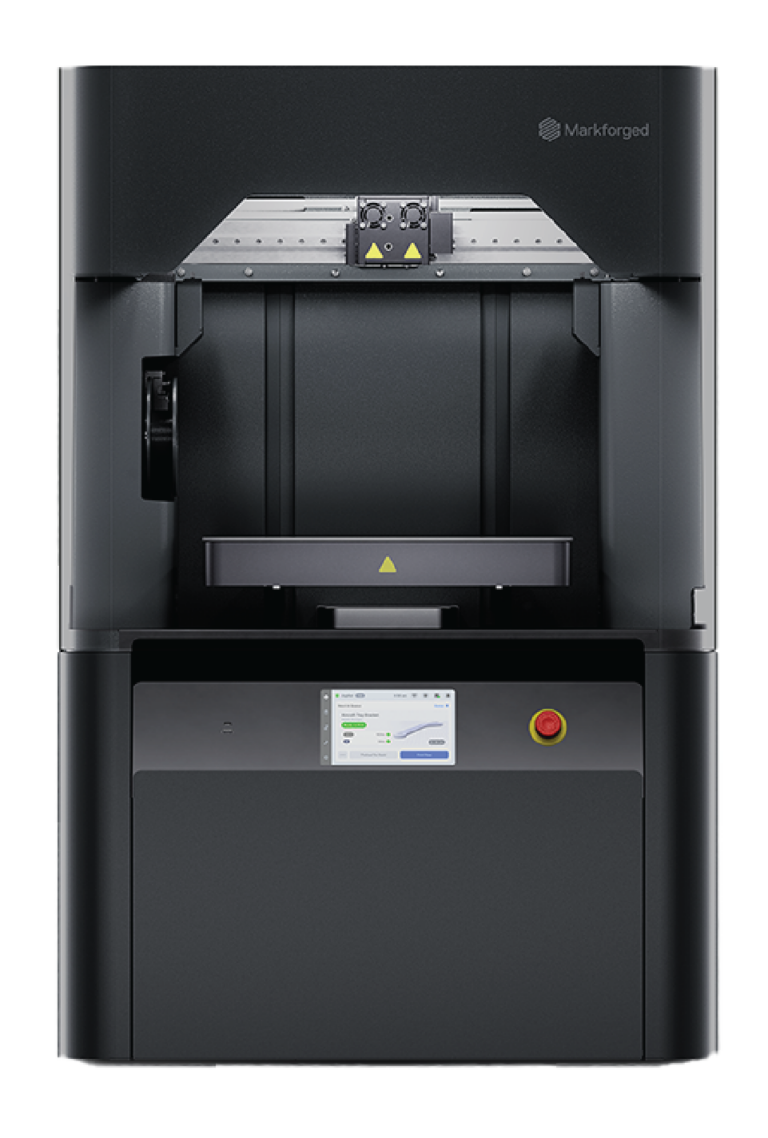
Markforged FX10
Published · Researched 2026-09-21
What does a $100,000 3D printer do that a $500 one doesn't? Almost nothing you'd notice on the first print. The FX10's trick is the hundredth print, the thousandth, the one that has to hold a bracket on a race car.
Markforged's machine (Watertown, MA; launched November 2023) is an industrial FFF printer with a second nozzle that lays continuous carbon fiber inside engineering thermoplastics — not chopped fiber mixed into filament, but unbroken strands of carbon routed through the part where the loads go. Swap in the optional Metal Kit (~15-minute engine swap) and it prints bound-powder metal filament — 17-4 PH, 316L stainless, H13 tool steel. Markforged calls it "the world's first industrial metal and composite 3D printer," which is marketing, but the capability underneath is real.
What's genuinely good: it behaves like factory equipment, not a printer. A fabrication specialist at Graham Rahal Performance told 3DPrint.com the FX10 is "basically like having that second hand" — 20–40 hours of fixture fabrication eliminated, 316L stainless exhaust flanges printed for a Lamborghini Revuelto. A Grassroots Motorsports forum user calls the Markforged line "an amazing machine," managed almost entirely through the web interface with barely any direct machine interaction. The specs back the autonomy story: 375 × 300 × 300 mm build volume, heated chamber to 60 °C, a laser micrometer plus vision module that validates dimensions mid-print ("Inspection"), auto-calibration, four sealed in-chamber spool bays with auto material changeover, direct-drive dual nozzles. Materials are the serious engineering set: Onyx (nylon + chopped carbon), Onyx FR, Onyx ESD, Nylon White FS (food-safe), plus continuous carbon fiber and carbon fiber FR. Reseller application engineers are consistently described as responsive and knowledgeable — the human support layer, as distinct from the corporate one, gets good marks.
What's actually wrong — and this needs the company context first, because it's the single biggest non-technical risk on the machine. Markforged is mid-acquisition. Nano Dimension completed its purchase in April 2025 ($116M / $5.00 per share); on May 27, 2026, Stratasys announced a definitive agreement to buy Markforged from Nano Dimension for $42.5M cash, expected to close in H2 2026. As of September 2026 the close is unverified. Nano keeps only the metal binder-jetting product line; the FX10, Digital Forge, and Eiger go to Stratasys. No service disruptions have been reported — but a six-figure machine with a corporate handoff in progress deserves a written answer from your reseller on who honors warranty and service after the close. Get it in the quote, not in a phone call. As of September 2026 the close still hasn't been confirmed as completed — "expected H2 2026" remains the official line. Context from the industry press: Stratasys CEO Yoav Zeif expects to "immediately reinvigorate revenue growth" by pushing Markforged through Stratasys's partner network, aimed at aerospace and defense, and Stratasys has also picked up Nexa3D's IP and hardware assets after Nexa3D shut down — it's collecting distressed additive-manufacturing assets, and Markforged (bought by Nano Dimension for $116M, sold on for $42.5M) is the clearest example. Meanwhile Markforged is litigating against Desktop Metal again — a new civil complaint alleging breach of their earlier settlement — so the legal overhang hasn't cleared either. None of this has stopped printers shipping, but it is the ownership weather on your six-figure machine.
Then the cost structure, which is the real criticism — not capability, never capability. The machine lists at $99,990 (Wurth Additive Group; Markforged.com itself is quote-only, and no other public US price exists — don't let anyone invent one). Onyx 800cc runs $190–$209. Carbon fiber runs ~$3.00/cc. Do that math on a part with serious fiber routing and you'll understand why owners talk about cost before they talk about anything else. Metal printing is not "printer plus kit": the FX10 plus Metal Kit (itself quote-only) prints the green part, which must then be debound in the Wash-1 solvent system and sintered in a Sinter-1 or Sinter-2 furnace — 26–31 hours per cycle, ~17 hours express for parts under 250 g. And the process guardrails matter more than the brochure admits: reseller documentation for 316L stainless lays out real limits — green parts must not exceed 96 hours total on the print bed (print plus paused time) or thermal debinding causes cracking and warp; wash must reach 3.5% mass loss in the Wash-1 before sintering or parts crack and wax clogs the furnace exhaust; sintering runs are capped at 500 g of total brown-part weight or the 316L chemistry goes inconsistent; and sintered rafts should be peeled off with pliers, because striking them with a hammer tarnishes the part. None of this is a dealbreaker — it's how the process actually behaves — but it's the operational detail that lives in the support docs, not the sales deck. Wash and furnace are major additional capital: a Polish reseller lists the complete FX10 + Wash-1 + Sinter-1 bundle at 1,186,490 zł (roughly $240k USD), with the Sinter-1 furnace alone at 359,490 zł. "The world's first industrial metal and composite 3D printer" does not mean one box. The Digital Forge subscription tiers (software + support + training) are quote-based. Materials are locked: chipped spools, Eiger slicer, no third-party materials. And the bed-adhesion system involves print-sheet/adhesive management complexity that the marketing gloss skips — a consumable-and-procedure layer worth knowing about before buying.
One more honest note on evidence quality, because it matters for a machine at this price. Almost all composite/metal capability claims trace to manufacturer or manufacturer-adjacent sources — official pages, reseller copy, industry coverage of company case studies. Independent third-party validation is scarce. The strongest "user" voices in this pass are a single racing-team case study and one forum thread — both positive, both single-source anecdotes. That's a Tier-3 evidence base, and it means this review is necessarily more cautious than the resin ones. The criticism that does exist is always about the price tag and the ownership carousel, never about the parts — which is reassuring but not proof.
Skip it if you can't get contractual clarity on post-acquisition service. Skip it if your parts don't actually need continuous fiber — an FDM machine at a tenth the price prints brackets; the FX10 prints brackets that replace aluminum. Skip it if you want metal without also buying a furnace, a wash station, and a 31-hour cycle.
The social pulse: thin, and I want to be honest about that. No dedicated FX10 owner threads surfaced on Reddit, no readable Facebook group posts, no Instagram sentiment, no owner how-to videos — the verdict rests on reseller material, a case study, and one forum thread. Older X-series platform voices (family-level context, not FX10-specific) repeat the same themes: material cost per part and the locked ecosystem. What exists is consistent — workplace owners describe a near-autonomous tool — but nobody has stress-tested the marketing in public.
Value call: ~$100k machine, plus materials, plus subscription, plus (for metal) wash and furnace — the full metal stack runs around a quarter-million dollars on a Polish reseller's public pricing, and even the composite-only machine has a new-in-box Australian listing at $115,000 AUD. There is no hobbyist value call here — the question is whether in-house continuous-fiber parts beat outsourcing them, and at $3/cc for fiber, the answer depends entirely on your volume and your tolerance for lead times. Compared to a Stratasys FDM at similar money, the fiber reinforcement is the differentiator; compared to a machine shop, it's the turnaround; compared to a used X7, it's the question of support terms under the new owner. A small used-market signal exists for the ecosystem, though not the FX10 itself: in the 2,000-member Markforged user group (which finally yielded readable posts in September 2026), an Onyx One Gen 2 sold the month — "my workhorse," low hours on a new print head, spares included — for $694, and another owner is hunting a Gen 1 motherboard because without it the printer is "dead weight," which is the legacy-parts-scarcity problem in one sentence. At this price the evidence gap matters: you are buying the brochure plus one racing team's endorsement. Price accordingly — with the service commitment in writing and the TCO spreadsheet open.
A near-autonomous composite and metal factory in a 122 kg box — priced like one, and currently changing owners like one.
Sources
- mark3d.com — retrieval date not recorded
- gsc-3d.com — retrieval date not recorded
- staging.awmiller.com — retrieval date not recorded