Resin (MSLA) printers, September 2026: who should buy what — and what to skip
Published · Researched 2026-09-20
A resin printer buys you one thing FDM can't: detail. Twenty-micron pixels lay down surface texture your eye can't quite resolve — the reason tabletop gamers, painters, jewelers, and modelers tolerate everything else. And the "everything else" is real: a resin printer is a purchase plus a chemistry setup. Before spending a dollar, know the single most important fact in this category: uncured resin is a sensitizer. Every skin exposure raises the odds of an allergic reaction — sometimes to the fumes alone — and the reaction doesn't fade once you have it. That's the 3dprinting.com 2026 safety guide, the CDC/NIOSH January 2025 sheet, and every serious owner thread. Budget $150–300 for the kit: half-face respirator with organic-vapor cartridges, 5+ mil nitrile gloves, safety glasses, ventilation ducted outside. If you can't vent the room, don't buy the printer. The carbon filters sold as accessories are odor control, not safety — an unvented filtered enclosure can be worse than an open ventilated one, because the fumes dump in one burst.
The economics are the second gut-check: the sticker price is roughly half your first-year spend. A wash-and-cure station is effectively mandatory ($99–160), resin runs $20–40/kg at the budget end, release film is a $10–15 wear item every few dozen prints, and the LCD screen itself is a consumable — ~2,000-hour life, ~$115 for a Saturn spare. If that made you flinch, FDM is the better hobby. Resin rewards people who want the detail badly enough to run the workflow.
The picks, by use case
"My first resin printer — I paint tabletop minis and want it to just work."
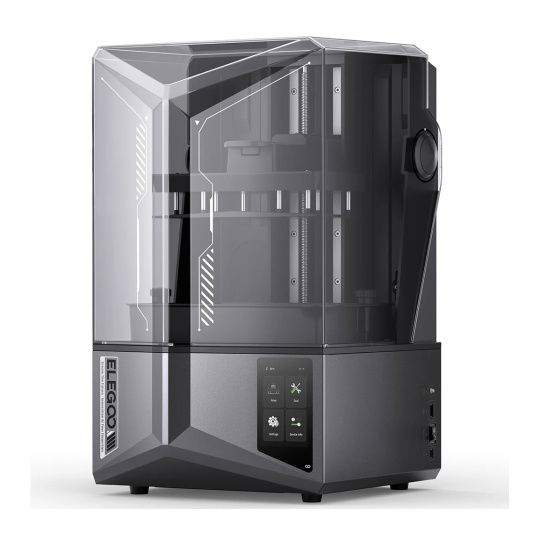
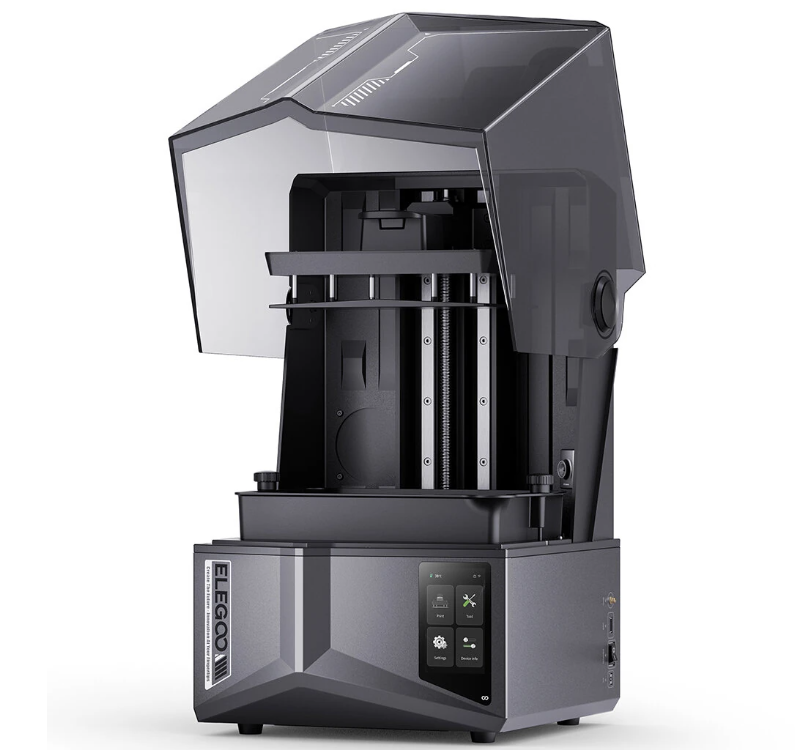
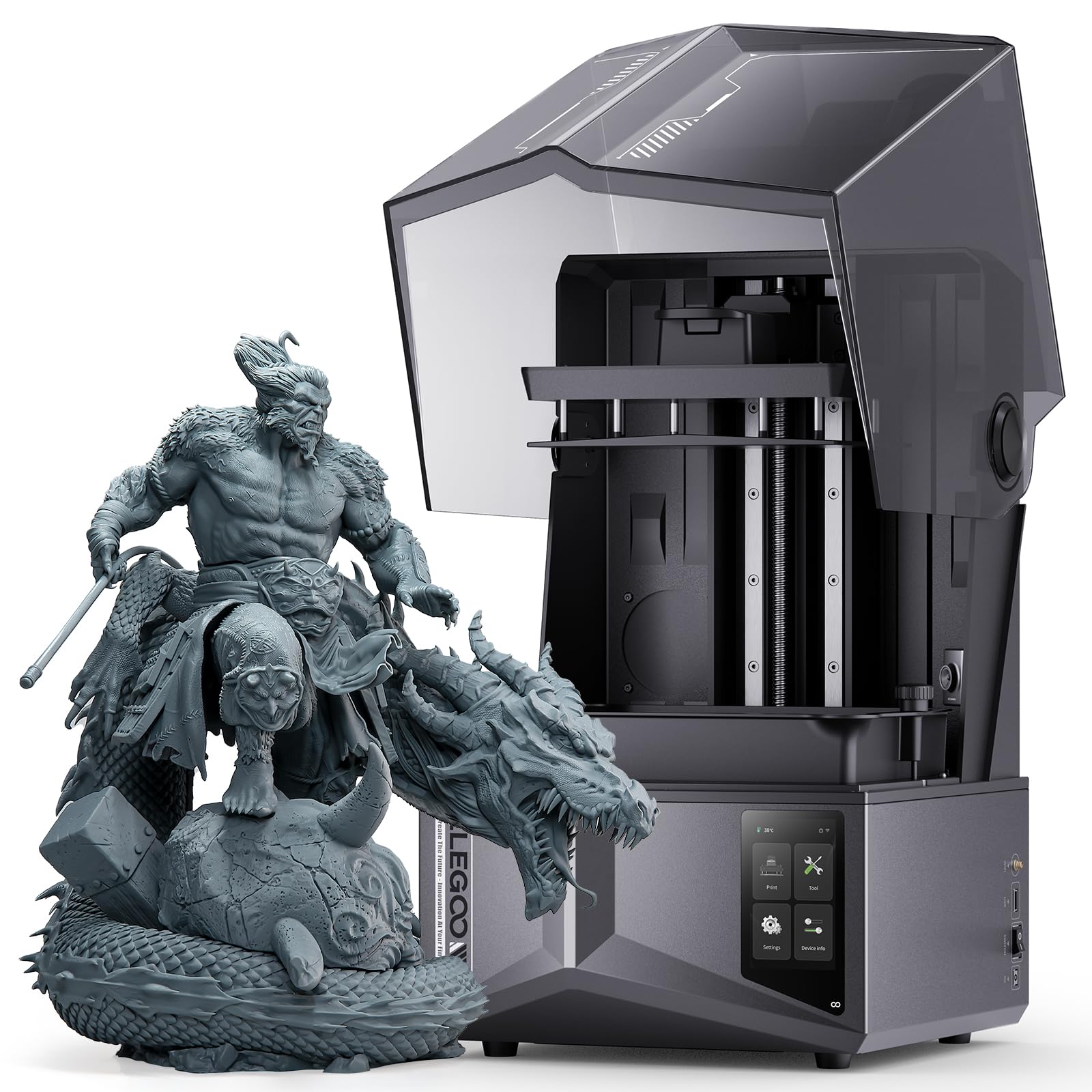
Buy the Elegoo Mars 5 Ultra ($259 on Elegoo's US store, observed 2026-09-20 during the ELEGOO DAY sale ending Sept 29 — re-verify after). The most settled verdict in the category: 9K screen at 18 µm, one-click auto-leveling, a tilt-release vat that peels layers gently and fast (up to 150 mm/h), Wi-Fi transfer, and smart sensors for resin shortages. 3dtechvalley gave it 9.5/10 and "Editor's Choice for Miniatures" in early 2026; Amazon owners rate it 4.2/5 across 88 reviews and call setup near-effortless. Tradeoffs: the AI camera is a time-lapse toy — reviewers watched it record failures — the 165 mm Z ceiling rules out tall pieces, and Elegoo's slow support is the top recurring owner complaint, so buy spare film up front. Budget escape hatch: the prior-gen Mars 4 Ultra ($200–260, manual leveling, same 9K-class resolution) is the smarter buy if you'd rather spend the difference on resin.
"Maximum detail per dollar — I'm a painter or jeweler and I see everything." Buy the Phrozen Sonic Mini 8K S ($270 on Phrozen's US store, observed 2026-09-20) — if you can get one. It was backordered with a mid-October 2026 ETA, and third-party US availability is patchy. When obtainable, its 22 µm 8K screen is the best detail-per-dollar print in 2026. The catch: stripped down by design — USB-only, no Wi-Fi, no built-in filter, 80 mm/h, a small 165×72×170 mm volume, and a plate that grabs prints hard enough to need lower bottom exposure. One honest caveat: the 18 µm vs 22 µm gap is nearly invisible in practice, so if Phrozen's stock is still dry, the Mars 5 Ultra covers 90% of this for the same money.
"Bigger pieces — busts, terrain, display models, cold garage." Buy the Elegoo Saturn 4 Ultra — the 12K (~$359) or 16K ($399 on Elegoo's US store, both observed 2026-09-20 during the sale). Tom's Hardware named it its best resin printer choice for 2025, and the 2026 circuit still rates it more reliable and better-supported than its Anycubic rival. Which one? The 16K adds finer pixels and tank heating that holds resin at 30 °C — the cold-room feature — but its XY footprint is slightly smaller, and a September 2026 review found them indistinguishable at normal viewing distance: the extra resolution pays off on display busts, not tabletop armies. So: 12K for minis and terrain, 16K for busts or unheated rooms. The alternatives: Anycubic's Photon Mono M7 ($493, observed 2026-09-20) is faster on paper (up to 150 mm/h with high-speed resin) with full 14K detail, but manual 4-point leveling, no heated vat, weaker automation — the sprinter. Anycubic's newer Photon P1 ($499 promo, observed 2026-09-20) is the reliability play: heated vat, ball-screw Z, deliberately slower (25–35 mm/h) — but it's a 2026 machine with no long-term owner reports yet, so it's review-circuit evidence only.
The traps
"Leveling-free" is copy, not a feature. The M7's own spec sheet says "Leveling-free" in one row and "4-point leveling" in the headline — third parties and the July 2026 hands-on review confirm it's manual with bolts. The P1's "Auto-Leveling 3.0" is pressure-sensor assisted, not magic. Don't buy an Anycubic on the leveling promise.
AI cameras that watch you fail. Both brands' cameras are sold as safety nets; reviewers found them missing failures entirely — one summarized the Mars 5 Ultra's camera as recording the failure without stopping the print. Treat it as a time-lapse feature.
The 16K's new-model quirks. A September 2026 owner thread documents a brand-new Saturn 4 Ultra 16K refusing to enable Print on any user-sliced file (factory test file worked; fix unknown), and another owner cracked the protector glass twice following the calibration wizard. The 12K has the longer, calmer record — buy the 16K knowing you're an early adopter.
Paying for 16K to print 28 mm minis. At tabletop distance, reviewers cannot tell the panels apart. The premium buys display-bust sharpness and a heater, not better goblins.
Last-gen Anycubic stock at near-current prices. The P1 has eclipsed the M5s Pro and M7 Pro as Anycubic's current mid-size pick — but both are still sold at some retailers ($579 and $562 official, observed 2026-09-20). Clearance discounts make them fair budget buys; near the P1's $499 promo, they don't.
The 3-month LCD warranty on the part that dies. Elegoo warranties the LCD for three months; LCD failure — dark spots, half-scrambled screens — is the #1 serious owner complaint across Reddit and Facebook in September 2026. Phrozen matches the 3-month warranty. LCD mortality is the universal MSLA tax: ~$115 for a Saturn spare, ~2,000 hours of life, bought before yours dies, because support tickets measured in weeks are what the owner threads report.
The fine print
Running costs, consolidated: budget resin $20–40/kg (sales push lower); wash/cure $99–160 (Mercury Plus 2.0 ~$99.99; Mercury XS bundle ~$115–119 on sale; Anycubic's Wash & Cure 3 Plus ~$150); release film $10–15 a sheet with a 30–40-print practical life; spare LCD ~$115; plus the $150–300 safety kit. Nobody includes resin, a station, or real PPE in the box.
Failure modes to expect, from the owner record: LCD death and dark spots (the big one); film wear, tears, and "bloating"; prints welded to laser-etched plates (lower bottom exposure); a USB-drive quirk on the Mars 5 Ultra where the plate stalled mid-print — printing from internal storage fixed it; false sensor alerts. That's the maintenance rhythm you sign up for.
Safety, once more, because it's always buried: respirator with organic-vapor cartridges (the dust masks in the box stop dust and nothing else), 5+ mil nitrile gloves changed often (thin gloves permeate in under an hour), splash-rated eye protection, ducted-out ventilation, IPA kept covered and away from ignition — and nothing down the drain. Cure all wash water and contaminated waste (gloves, towels, supports, failed prints) under UV or sunlight until solid, then bin it. Water-washable and "plant-based" resins are still skin sensitizers; the label changes cleanup convenience, not the hazard.
The bottom line
Buy now for miniatures and least-friction first ownership (Mars 5 Ultra, $259, before the Sept 29 sale ends) or mid-size prints on the proven platform (Saturn 4 Ultra 12K, $359 — the 16K only if busts or cold rooms justify it). Take the Anycubic M7 if raw speed per dollar beats automation; the Photon P1 if a cold workshop and reliability-first printing beat speed — knowing its long-term record is unproven. Wait on the Phrozen Mini 8K S (backordered) or the P1 with a full ownership record (none exists yet). And whoever you buy from: spend the safety money on day one, because resin's price on your lungs and skin is the only one in this category that's non-negotiable.
Sources
- ca.anycubic.com — retrieval date not recorded
- us.anycubic3d.com — retrieval date not recorded
- store.anycubic.com — retrieval date not recorded
- store.anycubic.com — retrieval date not recorded
- techradar.com — retrieval date not recorded
- fauxhammer.com — retrieval date not recorded
- fauxhammer.com — retrieval date not recorded
- 3dwork.io — retrieval date not recorded
- high-tech-mag.com — retrieval date not recorded
- 3dtechvalley.com — retrieval date not recorded
- 3dprinteddecor.com — retrieval date not recorded
- bikmantech.com — retrieval date not recorded
- manuals.plus — retrieval date not recorded
- dreaming3d.net — retrieval date not recorded
- couponsfromchina.com — retrieval date not recorded
- WWW.GROUPON.COM — retrieval date not recorded
- microcenter.com — retrieval date not recorded
- en.prnasia.com — retrieval date not recorded
- testmarket.io — retrieval date not recorded
- 123-3d.co.uk — retrieval date not recorded
- youtube.com — retrieval date not recorded
- youtube.com — retrieval date not recorded
- youtube.com — retrieval date not recorded
- youtube.com — retrieval date not recorded
- youtube.com — retrieval date not recorded
- facebook.com — retrieval date not recorded
- facebook.com — retrieval date not recorded
- facebook.com — retrieval date not recorded
- space.com — retrieval date not recorded
- fabbaloo.com — retrieval date not recorded
- store.anycubic.com — retrieval date not recorded
- store.anycubic.com — retrieval date not recorded
- store.anycubic.com — retrieval date not recorded
- 3dprinteddecor.com — retrieval date not recorded
- 3dprinteddecor.com — retrieval date not recorded
- medium.com — retrieval date not recorded
- youtube.com — retrieval date not recorded
- tomshardware.com — retrieval date not recorded
- tomshardware.com — retrieval date not recorded
- techradar.com — retrieval date not recorded
- 3dtechvalley.com — retrieval date not recorded
- 3dtechvalley.com — retrieval date not recorded
- cgmagonline.com — retrieval date not recorded
- amazon.ca — retrieval date not recorded
- amazon.de — retrieval date not recorded
- shopabunda.com — retrieval date not recorded
- shopabunda.com — retrieval date not recorded
- assets-global.website-files.com — retrieval date not recorded
- desertcart.com.sa — retrieval date not recorded
- store.anycubic.com — retrieval date not recorded
- 3dtechvalley.com — retrieval date not recorded
- vertex3d.co — retrieval date not recorded
- 3dprinting.com — retrieval date not recorded
- yankodesign.com — retrieval date not recorded
- us.elegoo.com — retrieval date not recorded
- eu.elegoo.com — retrieval date not recorded
- 123-3d.ie — retrieval date not recorded
- 3dwithus.com — retrieval date not recorded
- desertcart.in — retrieval date not recorded
- desertcart.in — retrieval date not recorded
- shopabunda.com — retrieval date not recorded
- gizchina.com — retrieval date not recorded
- tweakreviews.com — retrieval date not recorded
- creativebloq.com — retrieval date not recorded
- voxelmatters.com — retrieval date not recorded
- goonhammer.com — retrieval date not recorded
- youtube.com — retrieval date not recorded
- youtube.com — retrieval date not recorded
- youtube.com — retrieval date not recorded
- US.elegoo.com — retrieval date not recorded
- amazon.com — retrieval date not recorded
- 3dprinteddecor.com — retrieval date not recorded
- ubuy.hk — retrieval date not recorded
- game2gether.de — retrieval date not recorded
- us.elegoo.com — retrieval date not recorded
- us.elegoo.com — retrieval date not recorded
- ca.elegoo.com — retrieval date not recorded
- us.elegoo.com — retrieval date not recorded
- us.elegoo.com — retrieval date not recorded
- us.elegoo.com — retrieval date not recorded
- engineering.com — retrieval date not recorded
- technode.global — retrieval date not recorded
- cerebral-overload.com — retrieval date not recorded
- tomshardware.com — retrieval date not recorded
- 3djake.com — retrieval date not recorded
- tweakreviews.com — retrieval date not recorded
- bestchina3dprinters.com — retrieval date not recorded
- 3dprinteddecor.com — retrieval date not recorded
- gamingtrend.com — retrieval date not recorded
- firstquadcopter.com — retrieval date not recorded
- techtimes.com — retrieval date not recorded
- fauxhammer.com — retrieval date not recorded
- woodartsupply.com — retrieval date not recorded
- facebook.com — retrieval date not recorded
- facebook.com — retrieval date not recorded
- facebook.com — retrieval date not recorded
- facebook.com — retrieval date not recorded
- youtube.com — retrieval date not recorded
- cdn2.botland.store — retrieval date not recorded
- igeekphone.com — retrieval date not recorded
- images-na.ssl-images-amazon.com — retrieval date not recorded
- goonhammer.com — retrieval date not recorded
- gagadget.com — retrieval date not recorded
- us.phrozen3d.com — retrieval date not recorded
- gigaparts.com — retrieval date not recorded
- medimatch.co.uk — retrieval date not recorded
- dot3dfactory.com — retrieval date not recorded
- m.alza.cz — retrieval date not recorded
- hydrotech3dchennai.com — retrieval date not recorded
- 3idea.in — retrieval date not recorded
- ubuy.co.in — retrieval date not recorded
- tomshardware.com — retrieval date not recorded
- 3dtechvalley.com — retrieval date not recorded
- the3dprinterbee.com — retrieval date not recorded
- youtube.com — retrieval date not recorded
- youtube.com — retrieval date not recorded
- hackster.io — retrieval date not recorded
- liqcreate.com — retrieval date not recorded
- liqcreate.com — retrieval date not recorded
- dentallabnetwork.com — retrieval date not recorded
- therailwire.net — retrieval date not recorded
- therpf.com — retrieval date not recorded
- fauxhammer.com — retrieval date not recorded
- 3dprinting.com — retrieval date not recorded
- liqcreate.com — retrieval date not recorded
- 3dcaststore.com.au — retrieval date not recorded
- cdn.shopify.com — retrieval date not recorded
- skylabs.pk — retrieval date not recorded
- 3dprinting.com — retrieval date not recorded
- 3dprinting.com — retrieval date not recorded
- stacks.cdc.gov — retrieval date not recorded
- matterhackers.com — retrieval date not recorded
- technipages.com — retrieval date not recorded
- engineering.com — retrieval date not recorded
- fabbaloo.com — retrieval date not recorded
- hackaday.com — retrieval date not recorded
- monocure3d.com.au — retrieval date not recorded
- anycubic.biz — retrieval date not recorded
- siraya.tech — retrieval date not recorded
- britmodeller.com — retrieval date not recorded
- britmodeller.com — retrieval date not recorded
- gamesradar.com — retrieval date not recorded
- digitmakers.ca — retrieval date not recorded
- popsci.com — retrieval date not recorded
- wevolver.com — retrieval date not recorded
- ebay.com — retrieval date not recorded
- github.com — retrieval date not recorded
- cgmagonline.com — retrieval date not recorded


Named sources
- img.matterhackers.com — Supplied incomplete reference: https://img.matterhackers.com/g/...`
Source URLs were not recorded for these references.