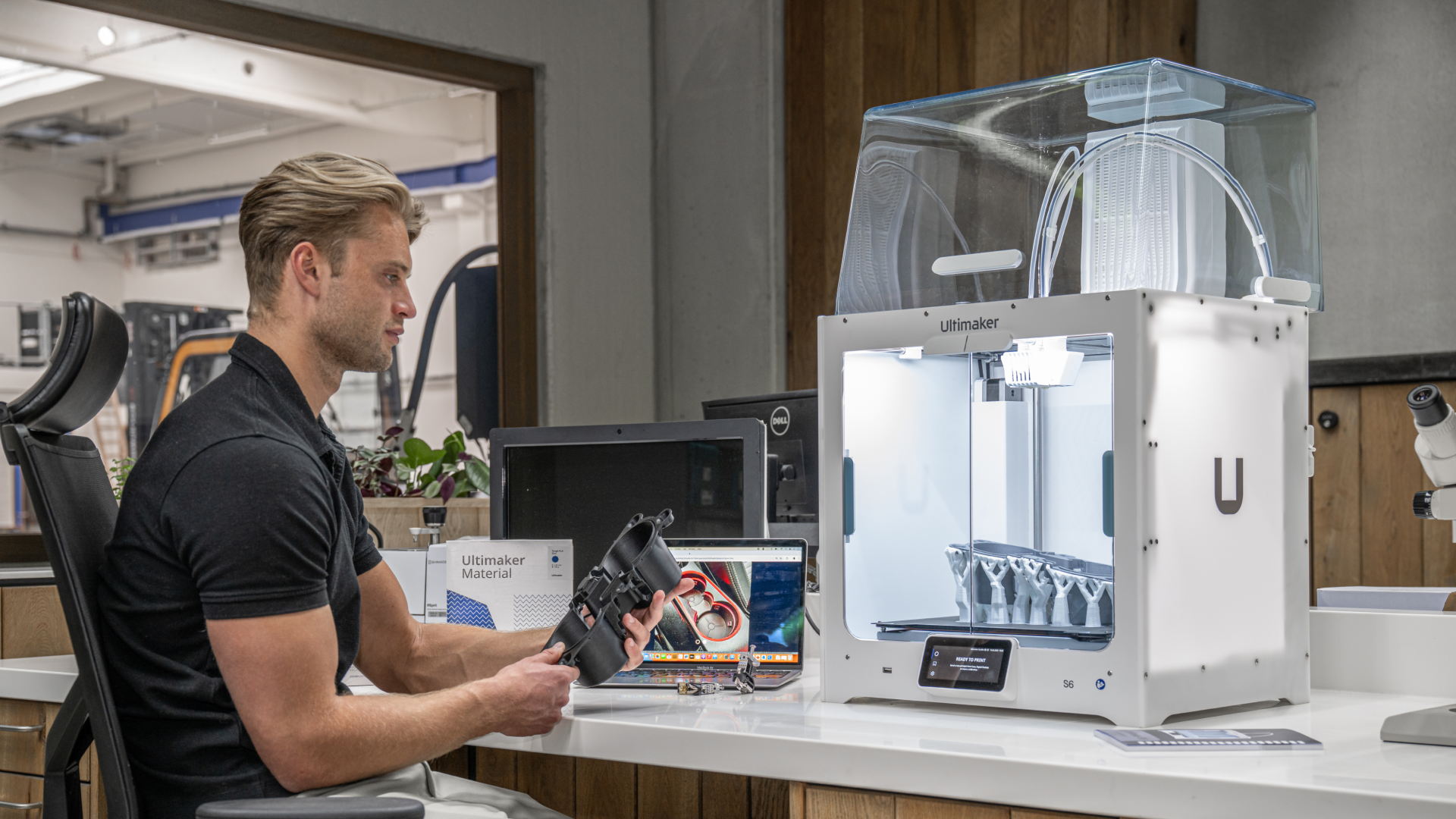
UltiMaker S6
Published · Researched 2026-09-21
The S6 costs $6,999. Say it again slowly, because everything about this review flows from that number: seven thousand dollars for a dual-extrusion printer with a 330×240×300 mm build volume, in a year when Bambu sells a bigger, hotter dual-nozzle machine for $1,549–$1,749 (BambuHub's July 2026 price tracking; the H2D Combo runs ~$2,000) and the new H2C at $2,199–$2,399. The S6 is not competing with Bambu. It's competing with the memory of the 40,000+ S5s already sitting in engineering departments — and for that specific buyer, it's the obvious upgrade.
What it is: UltiMaker's June 2025 successor to the legendary S5 — dual extrusion with auto nozzle-lifting, the new "Cheetah" motion planner claiming 4× S5 speed, 340 °C nozzle, 120 °C bed, 300+ material profiles on 2.85 mm filament, NFC spool recognition, and the Cura/Digital Factory ecosystem for fleet management. Street price $6,950–$6,999 in September 2026 (UltiMaker itself is quote-only), up from the $5,999 June 2025 pre-order price — the street has risen about a thousand dollars since launch. A TAA-compliant Secured Edition exists for defense buyers. Note on the file this review is built from: the research package is filed under the slug "ultimaker-s5" but covers the S6 as the current platform; the S5 itself is effectively legacy now, with reseller tables disagreeing on its price ($6,950 in one table, $4,999 in another — treated as disputed) and no formal discontinuation notice captured.
What's genuinely good has receipts. The speed claims hold up in independent testing: Appropedia's real-world gcode test printed the same tibial bone model in 13h 48m on the S5 and 7h 11m on the S6 — roughly a 2× real-world speedup, not the vendor's 4× timelapse claim, but real. The ecosystem is the moat: 300+ material profiles, swappable print cores, the Material Station's 6-spool NFC bay, full backward compatibility with the S5 (same cores, same stations, same air managers, and it reuses pre-sliced S5 files). For a department with five S5s, that compatibility is worth more than any spec. It's quiet (<50 dBA), it's made in the Netherlands, and Cura's 2026 changelogs show active software investment in S6/S8 material profiles. Launch customers praise the continuity: Schwartz Off Road Motorsportz says the S6 keeps "the same build quality and reliability that we've become accustomed to over the last five years with our S5" while adding speed, and DP3D France cites "speed and reliability" with the "well-integrated, proven ecosystem." Caveat, stated plainly: those are UltiMaker-supplied launch testimonials, not independent reviews — vendor evidence, not community evidence.
What's actually wrong starts with the price trajectory. The S6 launched at a $5,999 pre-order and now streets at $6,950–$6,999. Whatever the reason — tariffs, margin, positioning — the machine got $1,000 more expensive in its first year while competitors got cheaper. Seven thousand dollars buys you into 2.85 mm filament in a 1.75 mm world — fine if you're already in the UltiMaker ecosystem, a quiet tax if you're not. And the 2.85 mm tax is visible in the market: in the S5 Facebook group, owners are dumping sealed Ultimaker filament at roughly half price — ABS rolls that list around €48 going for €20, TPU 95A from €78 to €39, nylon from €72 to €39 — owners selling stock they can't return. That's ecosystem lock-in wearing a for-sale sign. The enclosed build-volume temperature is under 50 °C with open-loop control; the Air Manager (optional) is what makes it properly enclosed, and the Pro Bundle price wasn't captured.
Then the warranty, which the September 2026 deepening pass partially resolved and partially didn't. UltiMaker's own support page (fetched September 2026) says 12 months. But launch coverage consistently frames the S6 as "the first UltiMaker printer backed by an extended 24-month warranty (varies by region) — double the standard" (engtechnica, Manufactur3D Magazine, both June 2025), and resellers MatterHackers and 3D Universe advertise 24 months too. The MatterHackers fine print suggests the 24-month figure sits alongside an UltiMakerCare plan — so the honest version is: 12 months base on ultimaker.com, 24 months "varies by region" in launch press, possibly bundled with a service plan. Quote either number with the caveat attached, and get it in writing from your reseller before a procurement sign-off.
Now the used-S5 case, because this pass documented it directly. The S5's secondhand market is deep and cheap: a used S5 changed hands for $300 AUD in the Facebook group; a complete working kit with filament listed at €2,000; a thriving eBay parts trade (printhead $280, mainboard $320, LCD $130, print cores $65–75) keeps old machines alive. Owners buy secondhand cores, source print cores off eBay, and repair rather than replace. The group reads like a repairability success story — which is great news for a department already standardized on the platform, and quietly damning for the S6's value case: the used S5 does 80% of the job at 5–30% of the price, with the same ecosystem.
The deepest problem is evidential, and this pass sharpened it into something concrete: I browsed 39 posts in the "Ultimaker S5 Support" Facebook group (782 members, April 2024 → August 2026) — troubleshooting threads, for-sale posts, repair questions, filament dumps — and found zero discussion of the S6. Not one owner post, not one complaint, not one upgrade story. The S6's owners are engineering departments, not forum posters, so some of that absence is structural — but combined with the fact that no independent long-term S6 review exists anywhere (no university case studies, no reseller long-term reports, no forum troubleshooting threads; this session's web searches returned almost entirely repeated press-release syndication through Modern Plastics Korea, India, and Ireland), the honest statement is: nobody outside UltiMaker's launch-PR orbit has publicly evaluated this machine over the long term. That's a gap in the research, not a clean bill of health, and I'm stating it as such. The social pulse is really the S5's pulse, inherited: second-hand S5 buyers praise detail and precision ("fallen in love with the S5"), with the familiar complaints — slow by 2026 standards (slowness is the top surprise for new used-machine buyers), bed-leveling errors that need nozzle and bed cleaning, XY calibration drift on the second core, PVA supports that print well then degrade as layers progress, TPU stringing even on manufacturer profiles. That loyalty, plus full parts and file compatibility, is what the S6 is selling into. Nobody in the groups is arguing about the S6 itself. 2026 support-reputation specifics for UltiMaker are also missing from the file.
The 2026 value question is stark, so let's do the alternatives honestly. Against the Prusa XL+ ($2,999–$4,499): the XL+ gives you a true toolchanger, open-source firmware, and a better support reputation for thousands less — but no heated chamber, no 300+ validated material profiles, and no fleet-management ecosystem. Against the Raise3D Pro3 Plus HS ($7,599): similar money, similar professional positioning, heated-chamber competitors on both sides. Against the Flashforge Guider 3 Ultra (~$2,999): dual extrusion and a 600 mm Z for less than half. Against a used S5 ($300–$2,000): the entire ecosystem at a rounding error of the price, minus the Cheetah planner. Against the Bambu H2D ($1,549–$1,749): a bigger, hotter dual-nozzle machine for ~$5,000 less — and the S6 will lose that comparison on every spec line. The S6's answer to all of them is the same as it ever was: the ecosystem, the material library, the serviceability, the procurement-friendly vendor. If your organization buys printers the way it buys oscilloscopes — validated, serviceable, with a support contract — the S6 is the rational choice and the price is a line item. If you're buying with your own money, it isn't.
Bottom line: the best printer in this corpus for an engineering department that's already standardized on UltiMaker — and the worst value in this corpus for everyone else. The price went up $1,000 in a year; make sure the purchase order still makes sense.
Sources
- ultimaker.com — retrieval date not recorded
- matterhackers.com — retrieval date not recorded
- shop3duniverse.com — retrieval date not recorded
- bhphotovideo.com — retrieval date not recorded
- ultimate3dprintingstore.com — retrieval date not recorded
- ultimaker.com — retrieval date not recorded
- modernplasticsindia.in — retrieval date not recorded
- engtechnica.com — retrieval date not recorded
- manufactur3dmag.com — retrieval date not recorded
- ultimaker.com — retrieval date not recorded