Voltera V-One
Published · Researched 2026-09-21
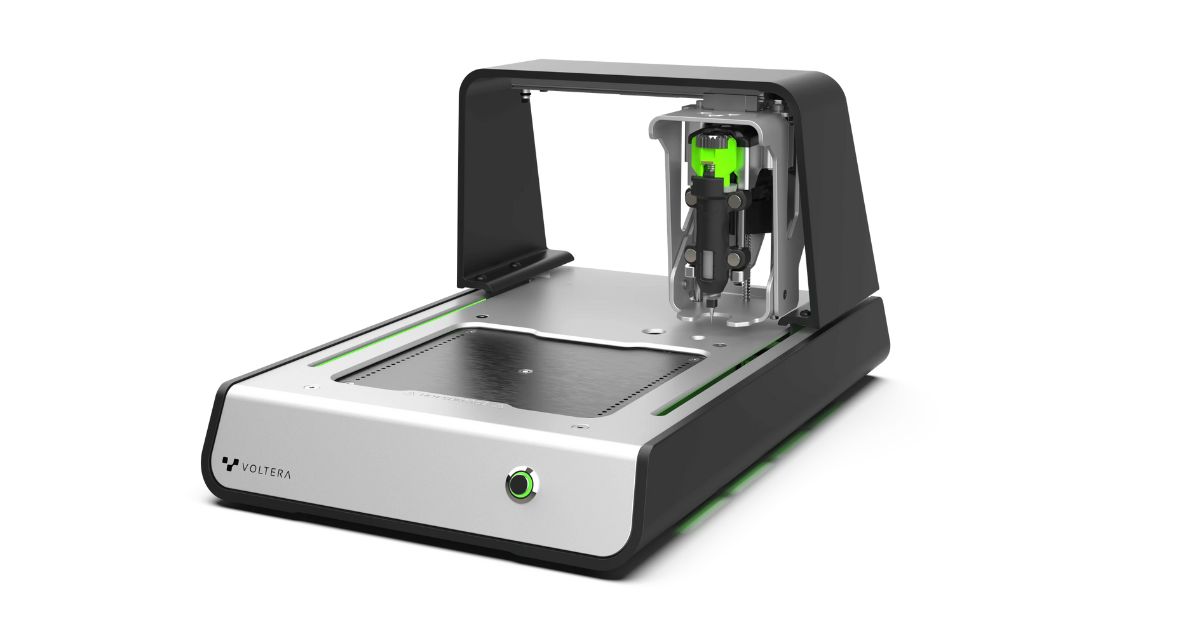
The Voltera V-One is the only machine in this project that doesn't make parts — it makes circuit boards, in under an hour, on your desk. Gerbers in, a functional two-layer prototype out.
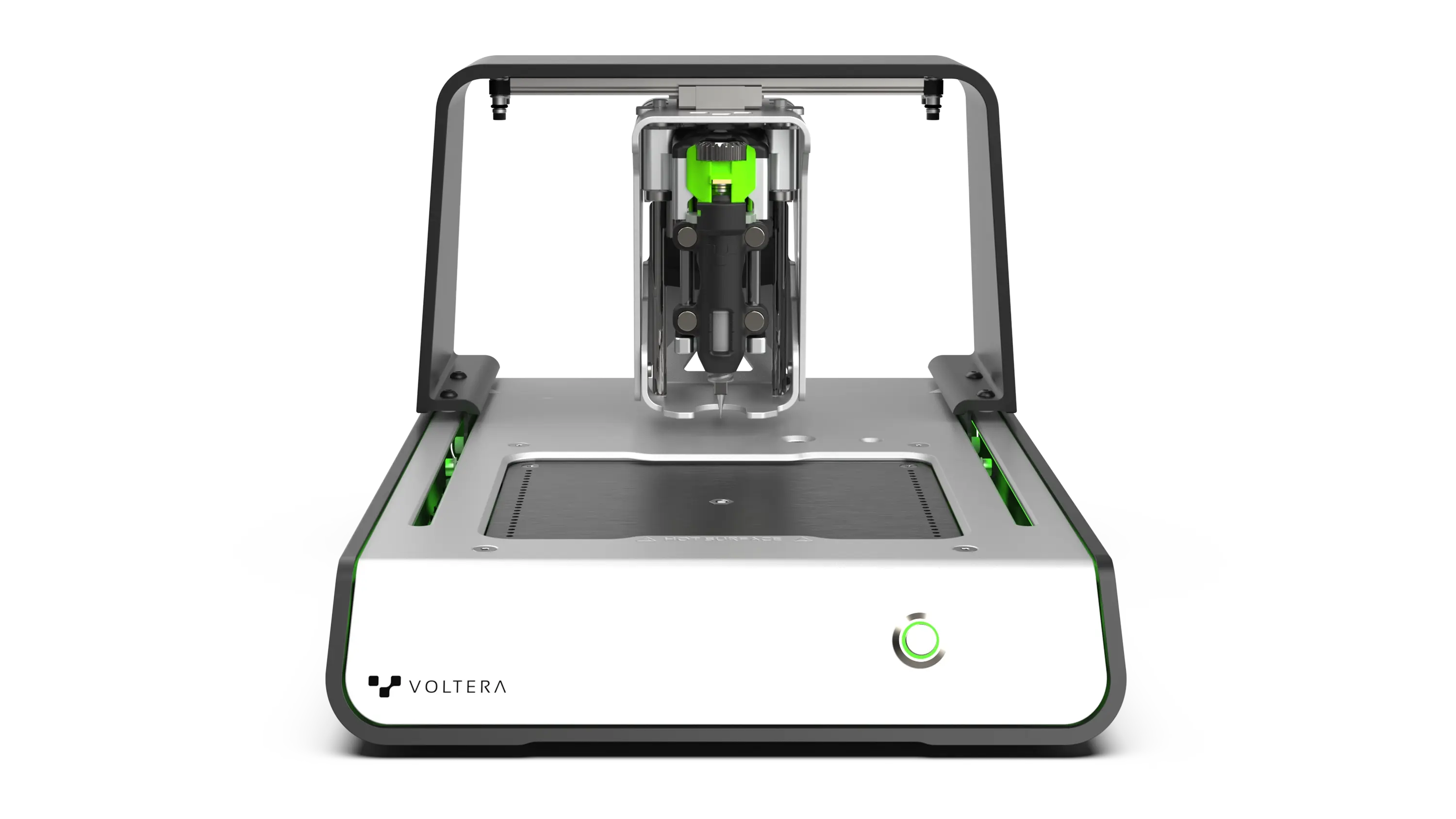
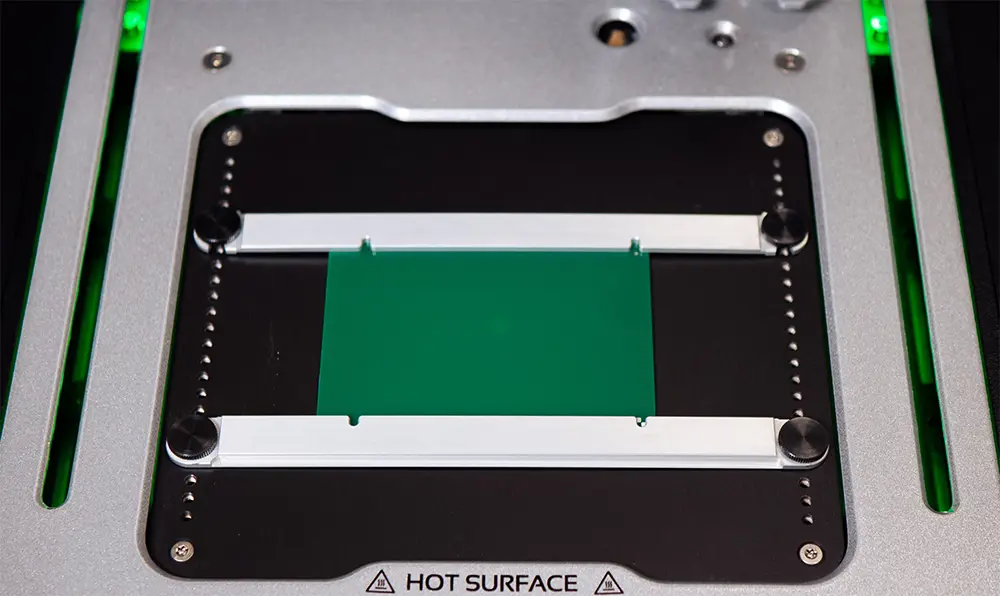
Voltera (Kitchener-Waterloo, Canada) launched the V-One on Kickstarter in 2015, and as of September 2026 it's still the current model — no V2 exists, and the newer NOVA platform is a sibling for flexible-electronics researchers, not a replacement. (If you see "Voltera Prisma" in project notes: no such product exists; the research searched for it.) It uses direct ink writing: a gantry moves toolheads that dispense silver conductive ink for traces, dispense solder paste, drill holes (with the optional $799.99 drill attachment), and then reflow components on a built-in heated bed. Current spec: 128 × 116 × 3 mm print area, 0.2 mm (8 mil) minimum traces, 0.5 mm pin pitch for paste, 0603 passives, rigid FR1/FR4 substrates, manual alignment with probe-based height mapping, and a 550 W integrated hot plate that reaches 240 °C in about a minute.
What's genuinely good: it does the thing it promises. The owner/maker verdict is remarkably consistent across a decade of sources — "if you need a PCB today, you can have your PCB today," in the words of the Successful Endeavours electronics-design consultancy. The stencil-free solder paste dispensing plus built-in reflow is the feature users say gets the most real-world use — including on factory-made HASL boards, which is a nice detail: you don't have to print the whole board on the V-One to get value from it. No stencils, no etching chemicals, no fab lead time, and your IP never leaves the building. The software imports Gerbers from EAGLE, Altium, KiCad, and the rest, runs on Mac/Windows/Linux. Named users include Dyson, Stanford's Bao Group, NASA, and Princeton — the kind of institutions that buy tools for iteration speed, not price. (Vendor claim; treat the name-drop as marketing, though the institutional profile rings true.)
What's actually wrong: the economics only work if time is the point. At $3,499.99 for the base unit plus $799.99 for the drill — call it ~$4,300 before consumables — the EEVBlog forum verdict stings because it's true: "you can get a lot of boards manufactured and express shipped for that price." The consumables are proprietary and perishable: conductive ink ~$100 a cartridge, solder paste $50–$60, nozzles $50–$60 per 4-pack — and the ink and paste must be refrigerated (4–10 °C) with limited shelf life. They expire whether you use them or not, so the running cost has a floor even in a slow month.
The capability ceiling is just as real, and it's worth enumerating because each one is a design constraint you'll hit. Vias are never truly plated — you drill the hole and hand-place a copper rivet, which is fine for prototypes and disqualifying for anything else. Traces can't run to the board edge. The pin-to-pin pitch floor is 0.8 mm for ink (0.5 mm for paste) — fine-pitch parts are off the table. Alignment is fiddly; calibration is manual. The ink is temperamental — clogging, continuity risk, shelf life. Great Scott!'s Hackaday hands-on stresses you must design boards with the machine's limits in mind; it's a design-for-V-One discipline, not a drop-in fab replacement. And it is no replacement for fabricated multilayer boards — it's a two-layer prototyping tool, full stop. Two concrete failure modes from real users flesh out the "temperamental" label: Make:'s reviewer found the machine over-dispenses solder on larger pads — the software calls for too much ink — and through-hole soldering sticks poorly to the printed ink traces (SMD work is fine; through-hole is the weak spot). And a GHI Electronics forum owner documented the height-mapping probe glitching — the nozzle tip contacting the board and snapping a $15 nozzle tip, plus one incident where it printed half an inch off the board in one corner and slung ink everywhere, suspected probe-data recording fault. Consumables are the recurring cost, but at least they're obtainable: third-party European electronics distributors stock Voltera ink and flux (solder-paste ink 2 ml ~€136, flux ~€27), so you're not hostage to one storefront.
And the support picture is the thinnest in this project: a 2-year warranty is included (5-year extended available at purchase), and Voltera now publishes human support hours — 9 a.m. to 5 p.m. ET, Monday through Friday — so support availability is documented. But no long-term owner reports on support responsiveness surfaced anywhere, and warranty-score panels show "not enough data." Treat support quality as unknown — for a $3,500 machine from a small Canadian company, that's a line item in the risk column, not a footnote.
Skip it if your boards are simple enough that a $5 fab order with express shipping beats same-day — for most hobbyists, it does. Skip it if you need plated vias, solder mask, multilayer, or fine-pitch parts below the machine's floor. Skip it if perishable $100 ink cartridges make your eye twitch. And skip it if you're buying it to avoid learning PCB design — the V-One punishes boards that weren't designed for it.
The social pulse: maker-community, not consumer — and remarkably stable. Sentiment comes from Hackaday (a 2015 review of unit #6, Great Scott!'s 2021 hands-on), EEVBlog forum threads, a GHI Electronics forum owner thread, a Hacker News thread, and maker blogs — no Facebook groups exist for Voltera, Instagram was unusable for sentiment, no Reddit threads surfaced, Threads was noise. There's a reason the hobbyist chatter is thin: Voltera's own figures put 200+ units in South Korean schools and universities by 2025, with Princeton's space-systems lab and the Circuit Launch hardware incubator as institutional users — the customer base skews education and R&D, not home benches. The shape of the debate hasn't moved in a decade: everyone agrees the machine works as advertised; the argument is purely economic and always the same — speed of iteration versus cost per board. Nobody claims it's a fab replacement; Voltera doesn't either. A consensus that stable is itself a signal: the product is what it is, and it isn't pretending otherwise.
Value call: ~$4,300 (base + drill) plus a few hundred in inks, paste, nozzles, and substrates to start — the starter/advanced/pro bundles ($221–$450) and the education bundle ($1,316.11, 20% off) soften it slightly. Against a board house: if you iterate a design five times in a week, the V-One pays for itself in avoided lead time and kept IP; if you order ten boards twice a year, it's an expensive toy. The drill at $799.99 is the awkward upsell — without it you can't do vias at all, so price it as part of the machine, not an accessory. Historic ~$2,199 reseller figures are stale; $3,499.99 is the current number. Resale exists (an unused unit went for $4,000 on Carousell) but that's one data point, not a market. Against etching at home: the V-One is the clean, stencil-free, chemical-free version of the same workflow, at 100× the entry price. Against the NOVA: different machine, different job — don't cross-shop them.
A legitimate niche tool for labs, classrooms, and R&D teams that need in-house iteration or IP control — and an indefensible purchase for everyone else, which is exactly what a niche tool should be.
Sources
- voltera.io — retrieval date not recorded
- voltera.io — retrieval date not recorded
- voltera.io — retrieval date not recorded